
Overcoming Digital Fatigue in Healthcare Workflows
Last Updated: November 4, 2026
Quick Summary
Overcoming digital fatigue in healthcare workflows means treating it as a leadership problem, not a tech problem: audit where cognitive overload and technostress build up, cut low-value clicks, triage alerts, set communication boundaries, and build the business case with measurable workflow gains. Leaders who fund more software without fixing workflow pay twice.
- Run a one-week audit asking five frontline staff to log every system they touch, for how long, and why.
- Tier every alert into hard stops, soft stops, and passive notices, then pull 30 days of alert logs to calculate override rates per rule.
- Define response windows for non-urgent messages and ban after-hours messaging except for true emergencies.
- Measure minutes of after-hours charting, time per high-friction task, voluntary turnover, and sick calls after system changes.
- Add duplicate-entry count per patient encounter as a fifth measure to expose the interoperability gap in concrete form.
Table of Contents
- Why Digital Fatigue Is a Leadership Problem, Not a Tech Problem
- How to Spot Digital Fatigue Before It Becomes EHR Burnout
- Step 1: Audit Where Cognitive Overload and Technostress Build Up
- Step 2: Use Healthcare Workflow Optimization to Cut Low-Value Clicks
- Step 3: Reducing Administrative Burden in Healthcare Starts With Alert Triage
- Step 4: Set Communication Boundaries That Prevent Digital Compassion Fatigue
- Step 5: Build the Business Case With Measurable Workflow Gains
- Step 6: Coach Leaders to Model Digital Empathy and System Usability
- Frequently Asked Questions
Why Digital Fatigue Is a Leadership Problem, Not a Tech Problem
Digital fatigue is the mental exhaustion that comes from constant interaction with screens, alerts, and software systems. In healthcare, that exhaustion shows up as slower charting, shorter fuses, and good clinicians quietly updating their resumes.
Across health systems, leaders often buy another tool, then wonder why the team is still worn down. The tool was never the problem. The way work is designed around it is.
A common mistake is treating digital fatigue as an IT ticket. Leaders who want to go further can explore character-driven leadership for healthcare to improve retention and team cohesion. It is not. It is a leadership issue, and it shows up in retention numbers long before anyone files a complaint.
- Nurses who dread logging in are already halfway out the door
- Managers who ignore the warning signs inherit the turnover
- Executives who fund more software without fixing workflow pay twice
If you want to understand what a re-engaged team looks like, start with how to improve team engagement in healthcare before you touch another platform.
How to Spot Digital Fatigue Before It Becomes EHR Burnout
EHR burnout is the point where documentation demands overwhelm a clinician's ability to care for patients well. It rarely arrives overnight. It builds through small, visible signals that leaders learn to read.
Watch for these early signs:
- Charting spills past shift end, night after night
- Staff copy the same data into two or three systems
- People stop asking questions in team huddles
- Sick calls rise on the days after a system update
- Experienced staff start mentoring less
What most guides miss is that the loudest complaints are not the real signal. The quietest people are usually the furthest along.
Step 1: Audit Where Cognitive Overload and Technostress Build Up
Cognitive overload happens when the volume of information a person must process exceeds what they can handle well. Technostress is the anxiety that comes from adapting to new or poorly designed technology. Both leave a trail you can map.
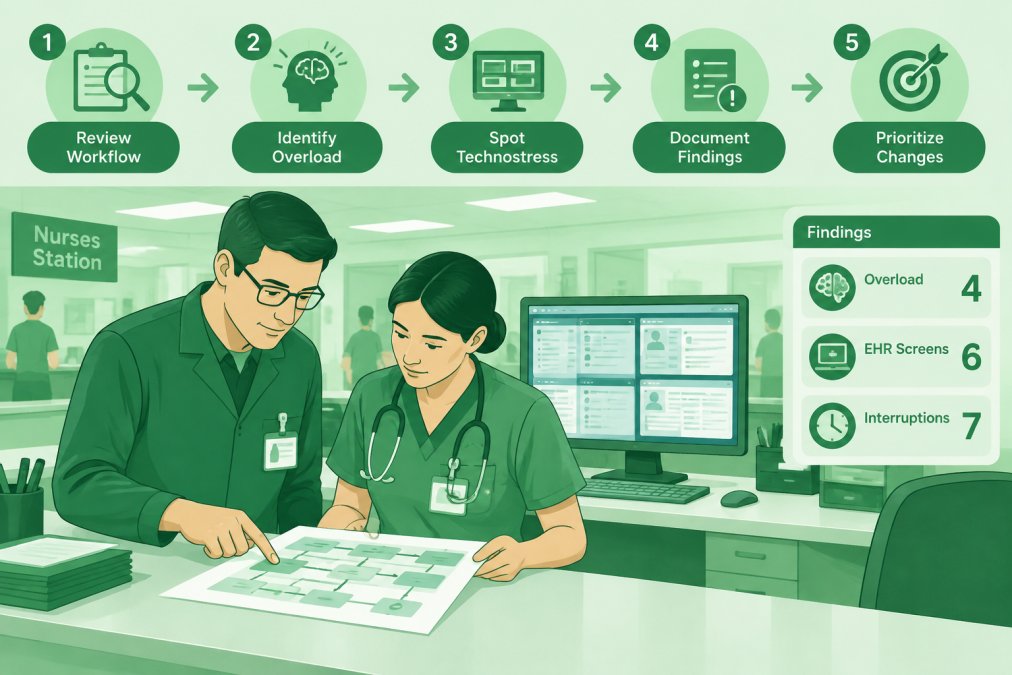
Run a simple audit over one week:
- Ask five frontline staff to log every system they touch, for how long, and why
- Time the three tasks people complain about most
- Note every duplicate entry point
- Mark where people wait on a system rather than a patient
You are not looking for villains. You are looking for friction. The Agency for Healthcare Research and Quality publishes practical workflow assessment guidance that can structure this exercise.
Step 2: Use Healthcare Workflow Optimization to Cut Low-Value Clicks
Healthcare workflow optimization means removing steps that add no clinical or financial value. That is it. Most teams already know which clicks are pointless; nobody has given them permission to say so. Empowering clinicians to eliminate these redundant tasks is particularly critical when refining the operating room workflow to ensure that technical precision remains the primary focus of every procedure.
Start with the obvious targets:
- Auto-populate fields that staff retype
- Merge duplicate order sets
- Move documentation to the point of care
- Kill reports nobody reads
Reducing administrative burden in healthcare is not a cost-cutting exercise. Every minute returned to a clinician is a minute returned to a patient, and that is the argument that survives budget season.
Step 3: Reducing Administrative Burden in Healthcare Starts With Alert Triage
Alert fatigue is the desensitization that sets in when a system fires so many notifications that people stop reading them. It is one of the clearest links between system design and patient safety, and it is measurable. The operational work is more specific than simply reducing alert volume.
Start by tiering every alert into three buckets, because a single priority scale collapses under its own weight:
- Hard stops, interruptive, block the order, and are reserved for true contraindications and critical lab values. These should be rare enough that a clinician can count them in a shift.
- Soft stops, interruptive but overridable, with a required reason. Use these for drug-drug interactions of moderate severity and duplicate-order warnings.
- Passive notices, routed to an inbox or digest, never a pop-up. Most "FYI" alerts belong here, and most alert volume problems are passive notices masquerading as hard stops.
Then run a diagnostic before you change anything. Pull 30 days of alert logs and calculate the override rate per rule. In many alert audits, a small number of rules generate most of the interruptions. A rule that is overridden almost universally is not protecting anyone; it is training staff to click through the next alert, including the one that matters. Review those rules with the clinical owners who requested them, not with IT alone.
Notification management follows a simple rule: every alert must earn its place.
- Rank alerts by clinical risk, not by who requested them
- Retire any rule whose override rate stays high after a redesign pass
- Route low-priority notices to a digest, not a pop-up
- Review alert volume monthly with frontline input, and publish the count
Watch out: removing an alert to quiet the noise can remove the only safeguard standing between a tired clinician and a harmful order. Retire rules only after the clinical owner signs off, and document the decision so the next safety review can see why it was made.
The Office of the National Coordinator for Health IT publishes guidance on clinical decision support design that helps teams set this up well, and the Agency for Healthcare Research and Quality has practical material on medication safety that pairs with alert redesign.
Step 4: Set Communication Boundaries That Prevent Digital Compassion Fatigue
Digital compassion fatigue is the emotional exhaustion that comes from being reachable, and expected to respond, at all hours. It hits the people who care most, and it hits them first.
Boundaries work when leaders set them publicly:
- Define response windows for non-urgent messages
- Ban after-hours messaging except for true emergencies
- Rotate on-call coverage so no one carries it indefinitely
- Model the boundary yourself, visibly
Leaders who want to set empathy-driven norms should start with these practical steps to develop empathy in leadership. Empathy without structure becomes another demand on tired people.
Step 5: Build the Business Case With Measurable Workflow Gains
Executives do not fund wellness. They fund outcomes. Frame digital wellness as an operational and financial case, and it moves. The angle that survives a budget meeting is narrower: fragmented, non-integrated systems create manual re-entry, and manual re-entry is a fatigue factor hiding in plain sight.
Interoperability belongs at the center of the case, not the margin. Every system that does not talk to the next one forces a clinician to read data in one window and type it into another. That is not just wasted time; it is a second cognitive task layered on top of the clinical one, and it is where errors cluster.
Measure four things before and after:
| What to Measure | Why It Matters | Where to Look |
|---|---|---|
| Minutes of after-hours charting | Direct sign of overload | EHR audit logs |
| Time per high-friction task | Shows workflow gain | Timed observation |
| Voluntary turnover on target units | Ties to replacement cost | HR records |
| Sick calls after system changes | Early warning signal | Scheduling data |
Add a fifth measure that most teams skip: duplicate-entry count per patient encounter. Walk a single discharge or admission and tally every field a clinician retypes because two systems do not share it. That number is the interoperability gap in concrete form, and it is the one administrators can act on without replacing the EHR.
Then translate the measures into the language finance uses. Use your own HR and scheduling data to estimate replacement cost per nurse and per physician on the target units. Multiply by the voluntary turnover you can plausibly attribute to workload, and present the result as a range, not a point estimate.
Watch out: a business case built on soft survey scores alone gets deferred. Anchor every claim to a system log, an HR record, or a timed observation, and label estimates as estimates so the numbers survive scrutiny.
Executives building the case should look at how leadership development for healthcare executives connects coaching to measurable outcomes before pitching the spend.
Step 6: Coach Leaders to Model Digital Empathy and System Usability
Digital empathy is the practice of designing and enforcing communication norms that respect the human on the other end of the screen. It is a skill, and skills are coachable.
Managers need three habits:
- Ask staff where the system slows them down, then act on the answer
- Protect focus time the same way you protect meeting time
- Escalate usability problems instead of telling people to work around them
System usability improves when leaders treat frontline feedback as design input. Coaching is what turns that intention into daily behavior. Our guide to leadership development for healthcare managers covers the core competencies involved.
The National Institute for Occupational Safety and Health frames worker wellbeing as an organizational design issue, which is exactly the frame leaders need here.
Digital fatigue will not fix itself, and another software purchase will not fix it either. It takes leaders who can see the pattern, set boundaries, and coach their teams through the change. Jim Carlough works with leaders on building confidence, clarity, and influence through character-driven leadership, developing the human skills that hold a team together. Book Jim to speak or explore executive coaching to build a team that can carry the load without breaking.
Frequently Asked Questions
What is digital fatigue in healthcare?
Digital fatigue is the mental exhaustion that builds when clinicians spend most of their day inside screens, alerts, and documentation systems. It shows up as slower charting, shorter patient conversations, and more errors at the end of a shift. In healthcare it is tied closely to cognitive overload and technostress, because the tools are constant and the stakes are high. Leaders who treat it as a workflow design issue, rather than a personal resilience issue, see better results from their teams.
How does EHR use contribute to clinician burnout?
EHR burnout grows from three things: data entry burden, alert volume, and fragmented screens that force repeated switching. When a clinician clicks through dozens of fields to document a routine visit, that time comes out of patient care or comes out of their evening. The fix is not a new system by default. Start by measuring where clicks and alerts cluster, then remove the low-value ones. Small workflow changes, applied consistently, reduce the daily load that pushes people toward burnout.
What workflow changes can reduce screen time for clinicians?
Begin with a short audit: shadow two or three clinicians for a shift and log every system they touch. You will usually find duplicate documentation, unnecessary logins, and alerts that fire without a clear action. Then apply healthcare workflow optimization in small steps, such as consolidating order sets, batching non-urgent messages, and moving routine data capture to support staff. Track minutes saved per shift rather than impressions. Those minutes are the number your CFO will care about when you ask for budget.
How can managers support staff experiencing digital fatigue?
Managers can do three things well. First, set explicit communication boundaries, such as no non-urgent messages after shift end, and hold to them yourself. Second, review alert and inbox volume with your team monthly and escalate anything that adds work without adding safety. Third, protect recovery time in the schedule instead of assuming people will find it. Digital compassion fatigue is real, and it often starts with leaders who model always-on behavior. What you tolerate becomes the standard.