
Character-Driven Leadership for Healthcare: 7 Principles
Table of Contents
- Why Character-Driven Leadership Matters in Healthcare
- Impact of Leadership on Patient Outcomes
- Seven Core Principles of Character-Driven Leadership
- 1. Build Trust Through Transparency and Consistency
- 2. Develop Self-Awareness in Your Leadership Style
- 3. Lead with Empathy and Emotional Intelligence
- 4. Make Mission-Oriented Decisions
- 5. Foster Psychological Safety in Clinical Teams
- 6. Demonstrate Moral Courage in High-Pressure Environments
- 7. Model Accountability and Professional Conduct
- Ethical Leadership in Healthcare Examples
- Healthcare Leadership Development Programs That Build Character
- Character-Driven Crisis Management in Clinical Settings
- Measuring the ROI of Character-Based Leadership
- Conclusion
Last Updated: August 16, 2026
Why Character-Driven Leadership Matters in Healthcare
Character-driven leadership for healthcare has become essential for organizations struggling with team engagement, staff retention, and clinical outcomes. Unlike traditional leadership approaches that emphasize titles and hierarchies, character-driven leadership focuses on intentional development of identity, integrity, and human connection. In clinical settings, a leader's character shapes psychological safety, determines whether staff speak up about safety concerns, and influences whether emerging leaders feel prepared for larger roles. When leaders prioritize character over credentials, accountability becomes mutual rather than punitive, difficult conversations happen earlier, and professional conduct becomes a shared standard rather than a compliance checkbox.
At Jim Carlough, we've spent over 30 years analyzing what separates healthcare organizations with strong team cohesion and patient outcomes from those struggling with turnover and burnout. The pattern is consistent: character-driven leadership transforms how teams think about identity, influence, and their role in the mission.
Impact of Leadership on Patient Outcomes
Leadership character directly influences clinical excellence and patient outcomes. When leaders demonstrate transparency, accountability, and moral courage, clinical teams respond by raising safety concerns earlier, collaborating more effectively across disciplines, and maintaining focus on mission-driven decision-making even under pressure.
Research consistently shows that staff retention improves dramatically when leaders prioritize character-based trust. Teams with leaders who demonstrate consistency, empathy, and ethical clarity report higher engagement and lower burnout, translating to better continuity of care, fewer medical errors, and stronger patient satisfaction. A leader who models accountability creates an environment where near-miss reporting increases, interdisciplinary collaboration strengthens, and staff feel psychologically safe raising concerns that protect patients.
The impact extends to succession planning. Organizations that invest in character-driven leadership see emerging leaders develop faster because they have models to emulate and understand not just what leadership looks like, but who they're becoming as leaders.

Seven Core Principles of Character-Driven Leadership
The foundation of character-driven leadership for healthcare rests on seven interconnected principles that leaders can develop intentionally through deliberate practice, self-awareness, and commitment to professional conduct.
1. Build Trust Through Transparency and Consistency
Trust cannot be demanded or inherited with a title; it must be built daily through transparent communication and consistent action. When leaders say what they mean, follow through on commitments, and explain their reasoning, especially during difficult decisions, they establish the foundation for psychological safety and team cohesion.
Transparency means sharing information about organizational changes, budget constraints, and strategic decisions as early as possible, explaining the "why" behind decisions, not just the "what." When implementing an unpopular policy, transparency means acknowledging the constraint, explaining the reasoning, and inviting input on implementation. Consistency means leaders don't shift their values based on who's in the room or what's convenient; the same standards apply to everyone. Effective leaders are transparent about constraints while remaining flexible about solutions, and consistent about values while remaining adaptive about methods.
2. Develop Self-Awareness in Your Leadership Style
Self-awareness is the foundation for all other character development. Leaders who understand their default patterns, emotional triggers, and impact on others can make intentional choices rather than defaulting to habit. This requires honest reflection about how you show up under pressure, what situations activate defensiveness, and where your values sometimes conflict with your actions.
The most effective approach involves multiple feedback sources: direct reports, peers, mentors, and structured assessments. Many leaders are surprised by how their intentions differ from their impact. A leader who believes they're collaborative might be perceived as controlling. Once you see these gaps clearly, you can choose differently.
3. Lead with Empathy and Emotional Intelligence
Empathy in healthcare leadership is the ability to understand what's actually happening for your team members and respond appropriately. Leaders with high emotional intelligence notice shifts in team dynamics before they become crises, recognize burnout signals in high performers, and understand that a clinician's mistake might stem from inadequate training, unclear protocols, or personal stress rather than carelessness.
Empathy also means recognizing the emotional labor inherent in healthcare work. Clinicians carry the weight of patient outcomes, moral complexity, and constant decision-making under uncertainty. Leaders who acknowledge this burden rather than minimizing it create space for resilience and model how to process difficult situations.
4. Make Mission-Oriented Decisions
Healthcare leaders face constant decisions where competing values collide: efficiency versus thoroughness, cost containment versus optimal care, individual needs versus organizational sustainability. Mission-oriented decision-making means returning consistently to the core purpose, patient outcomes and professional conduct, rather than defaulting to convenience or politics.
This principle requires clarity about what you're actually optimizing for. A leader might decide to cut costs in one area to protect clinical staffing in another, but that decision should be transparent and intentional. Mission-oriented decision-making also means being willing to challenge decisions that don't align with stated values and advocating clearly before compliance.
5. Foster Psychological Safety in Clinical Teams
Psychological safety, the belief that you can take interpersonal risks without fear of punishment or humiliation, is essential for clinical excellence. Teams where members feel safe speaking up about safety concerns catch errors earlier and collaborate more effectively.
Building psychological safety requires consistent modeling. Leaders must respond to bad news with curiosity rather than blame. When someone reports a near-miss, the leader's response sets the tone for whether future concerns get reported or hidden. The balance between psychological safety and accountability is clarity: safety about raising concerns, accountability for outcomes. A clinician should feel safe reporting a medication error without fear of humiliation, while remaining accountable for following protocols that prevent errors.
6. Demonstrate Moral Courage in High-Pressure Environments
Moral courage is the willingness to do what's right even when it's costly, uncomfortable, or unpopular. In healthcare, this might mean speaking up about unsafe staffing ratios, refusing to implement a policy you believe violates patient welfare, or addressing a colleague's conduct that compromises care.
High-pressure environments test character. When a unit is short-staffed and patient volume is high, it's tempting to cut corners. Leaders with moral courage maintain standards even when it's harder and acknowledge the strain honestly. Moral courage also means admitting when you're wrong and adjusting course, teaching teams that mistakes are learning opportunities rather than career-ending events.
7. Model Accountability and Professional Conduct
Accountability means owning your decisions and their consequences rather than blaming circumstances or other people. In healthcare, this is particularly important because decisions have life-and-death implications. When leaders model accountability, they create cultures where responsibility is clear and shared.
Professional conduct includes how leaders treat people, the same respect for housekeeping staff as for physicians, the same responsiveness to concerns from new nurses as from senior clinicians. It means maintaining appropriate boundaries while remaining genuinely connected.
Ethical Leadership in Healthcare Examples
Character-driven leadership becomes concrete through examples. Consider a department head who discovers that a well-liked senior clinician has been consistently documenting procedures that weren't actually performed. The character-driven approach is transparent investigation, honest conversation about what happened and why, and clear consequences applied consistently. Other team members see that accountability applies equally regardless of seniority or popularity.
Another example: a unit manager notices that staff are working through lunch regularly to keep up with patient load. Rather than praising this dedication, the character-driven leader sees it as a system problem. She documents the staffing gap, escalates it with data, and advocates for additional resources. If the organization can't provide them, she's transparent about that constraint while protecting her team from unsustainable expectations. These examples illustrate that ethical leadership is about consistent choices where values guide action.
Healthcare Leadership Development Programs That Build Character
Healthcare organizations increasingly recognize that character-driven leadership requires intentional development. Effective programs go beyond one-time training to create ongoing opportunities for self-reflection, feedback, and deliberate practice.
The most effective approaches include structured coaching that addresses real workplace situations. Rather than generic leadership training, character-focused programs help leaders examine specific challenges: How do I respond when a team member disagrees with me? How do I balance empathy with accountability? Peer cohorts also accelerate development; when leaders from different departments meet regularly to discuss real challenges, they learn from each other's experience and build networks of mutual accountability.
Feedback mechanisms are essential. Leaders need to understand their actual impact on teams through 360-degree assessments, team pulse surveys, or regular one-on-ones where direct reports feel safe sharing honest feedback. Mentorship relationships where experienced leaders guide emerging leaders also benefit organizations, particularly when mentors explicitly discuss character development and how they've navigated ethical dilemmas.
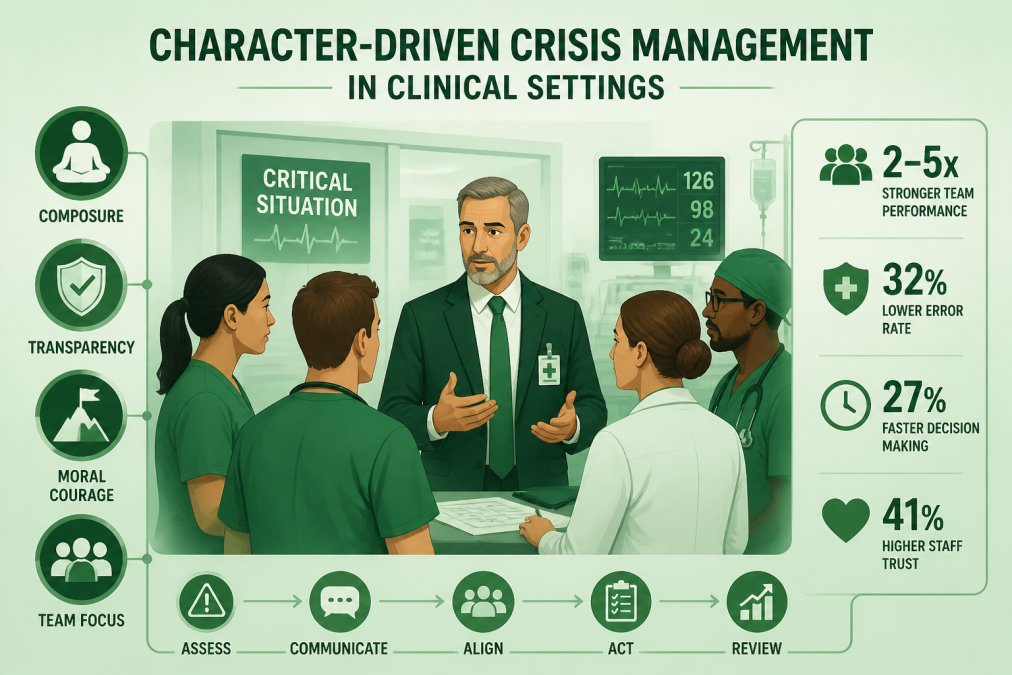
Character-Driven Crisis Management in Clinical Settings
Character-driven leadership becomes most visible during crises. A patient safety event, staff misconduct, or sudden staffing shortage reveals what leaders actually value and how they respond under pressure. Teams remember how their leader showed up during the crisis more than what they said in regular times.
Effective crisis management starts with composure. When leaders remain calm, teams can focus on solving the problem rather than managing the leader's emotions. A leader might say, "This is a serious situation. We're going to work through it systematically. Here's what we know, here's what we need to figure out, and here's how we'll proceed." This clarity is reassuring even in difficult circumstances.
Transparency during crises builds trust for the long term. When something goes wrong, teams want to know what happened, why it happened, and what comes next. Clear communication, even if it's "We don't know yet, but here's how we'll find out," is better than silence. Moral courage during crises means doing what's right even when it's costly, addressing systemic problems rather than quick fixes and handling violations transparently rather than protecting reputations at the expense of organizational integrity.
Measuring the ROI of Character-Based Leadership
Healthcare organizations often ask how to measure the return on investing in character-driven leadership. Staff retention is the most direct measure; organizations that invest in character-driven leadership see lower turnover, particularly among high performers. Replacing a clinician costs significant money in recruiting, onboarding, and lost productivity.
Patient safety metrics improve when leaders create psychological safety. Near-miss reporting increases because staff feel safe reporting concerns. Infection rates, readmission rates, and medication error rates often improve as teams collaborate more effectively. Engagement scores and culture assessments show measurable shifts in trust, communication clarity, and sense of mission.
Succession readiness is another key indicator. Organizations that develop character in leaders see faster pipeline development because emerging leaders are more prepared for promotion. Some of the most important benefits are difficult to quantify, a leader's moral courage might prevent a costly ethical violation, or psychological safety might prevent a serious error. These prevented problems don't show up as positive metrics; they show up as the absence of negative ones. Measurement requires looking at multiple indicators rather than a single number.
Character-driven leadership for healthcare isn't a nice-to-have leadership philosophy; it's essential infrastructure for clinical excellence, staff retention, and organizational resilience. Teams led by leaders who prioritize character, transparency, and mission-driven decision-making outperform those led by leaders focused primarily on efficiency or compliance. If your organization is struggling with engagement, succession planning, or cultural challenges, the foundation is often leadership character. Jim Carlough works with healthcare leaders and organizations to develop character-driven approaches that transform team dynamics and outcomes. Through executive coaching, keynote speaking, and developmental programs grounded in 30+ years of enterprise transformation experience, we help leaders build the confidence, clarity, and influence that create lasting change. Book Jim to speak at your organization or explore how character-driven leadership development can strengthen your leadership pipeline.
Frequently Asked Questions
What are the core traits of character-driven leadership in healthcare?
Character-driven leadership in healthcare centers on integrity, self-awareness, empathy, and accountability. These leaders prioritize patient-centered care and clinical excellence by building trust through transparency and consistency. They make mission-oriented decisions, demonstrate moral courage under pressure, and foster psychological safety within their teams. Unlike competence-based leadership that focuses solely on technical skills, character-driven leadership develops the human dimensions that enable teams to navigate complexity, reduce burnout, and improve patient outcomes through authentic connection and ethical decision-making.
How does character-driven leadership improve patient safety?
Character-driven leaders create environments where staff feel safe reporting errors, asking questions, and speaking up about patient concerns without fear of retaliation. This psychological safety directly improves patient outcomes by enabling better communication across interdisciplinary teams, reducing missed diagnoses, and catching potential safety issues early. When leaders model transparency and accountability, teams trust that mistakes will be addressed constructively rather than punitively. This culture of openness, combined with the leader's commitment to ethical decision-making and patient-centered values, strengthens clinical excellence and reduces preventable adverse events.
Why is ethical leadership critical in the healthcare industry?
Healthcare leaders make decisions that directly affect human lives, from resource allocation to patient care protocols to staff deployment during crises. Ethical leadership ensures decisions prioritize patient welfare, staff wellbeing, and organizational integrity over convenience or profit. In high-pressure environments, ethical leaders demonstrate moral courage by standing firm on values even when pressured. This builds staff retention, reduces burnout, strengthens organizational culture, and protects the institution's reputation and regulatory standing. Ethical leadership also models professional conduct that cascades through clinical teams, influencing how frontline staff interact with patients and each other.
How can healthcare organizations foster character-based leadership at all levels?
Organizations build character-driven leadership through intentional development programs that go beyond technical training. Start by assessing leaders' self-awareness through feedback mechanisms and coaching. Create mentorship and succession planning that pair emerging leaders with senior leaders who model integrity and emotional intelligence. Embed character dimensions into hiring, promotion, and performance evaluation criteria. Provide ongoing leadership development focused on resilience, empathy, and transformational practices rather than just competency checklists. Finally, establish accountability systems that reinforce ethical decision-making and transparency, making character development a strategic priority rather than an optional initiative.
This article was written using GrandRanker