
BlOG

Executive Leadership Coaching for Confidence: A 2026 Review
Table of Contents
- What Executive Leadership Coaching for Confidence Actually Does
- The Core Benefits: From Imposter Syndrome to Executive Presence
- Executive Coaching Cost Per Hour and ROI Expectations
- Leadership Confidence Building Exercises Within Coaching
- How to Find an ICF Certified Executive Coach
- Executive Coaching vs. Mentoring vs. Therapy: What's the Difference
- Character-Driven Leadership: Moving Beyond Titles
- Conclusion
Last Updated: August 15, 2026
What Executive Leadership Coaching for Confidence Actually Does
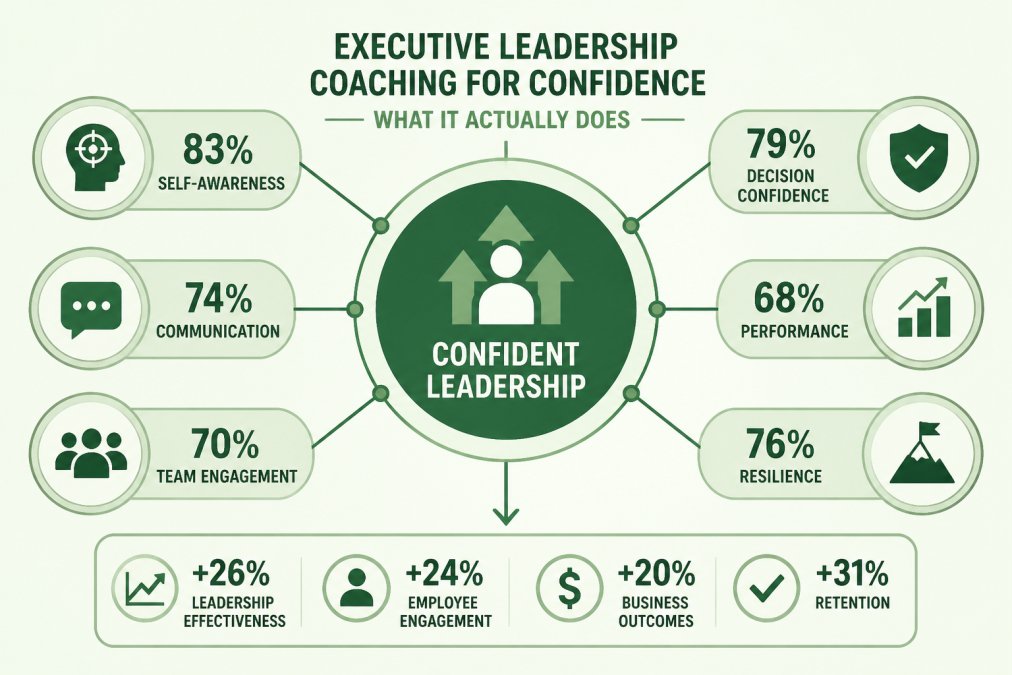
Executive leadership coaching for confidence addresses a specific problem: capable leaders who doubt their right to lead. You've earned the title, hit the metrics, made the decisions. Yet when you walk into a boardroom or address your team, something shifts. The voice gets quieter. The conviction wavers.
That gap between competence and confidence isn't a character flaw. It's a skill gap. And it's fixable.
Executive leadership coaching works by building three things in parallel: self-awareness about where doubt originates, concrete behavioral tools to project presence under pressure, and accountability structures that force you to practice new patterns until they become automatic. Unlike generic confidence workshops, real coaching digs into the specific moments where you lose presence and rebuilds how you show up in those exact situations.
The best coaches don't sell you confidence. They sell you clarity about your actual strengths, honest feedback about where you're undermining yourself, and a framework for practicing new leadership behaviors until they feel natural. At Jim Carlough, the focus is on character-driven leadership, the idea that authentic confidence comes from leading with intention and integrity, not from manufactured charisma or manipulation tactics. When you know who you are as a leader and what you stand for, the confidence follows.
The Core Benefits: From Imposter Syndrome to Executive Presence
The benefits of executive leadership coaching for confidence cluster into three categories: psychological, behavioral, and organizational.
Overcoming Psychological Barriers to Confidence
Imposter syndrome affects roughly half of high-performing leaders at some point. You attribute accomplishments to luck, timing, or help from others. You wait for someone to expose you as a fraud.
Real coaching addresses this by separating the feeling from the fact. A skilled coach helps you catalog evidence: decisions that worked, problems you solved, teams you built or turned around. When you can point to specific, measurable outcomes you created, the imposter narrative loses power.
The psychological work also involves identifying the specific triggers that undermine you. For some leaders, it's authority figures. For others, it's visibility or decision-making under uncertainty. A good coach names these patterns and gives you tools to interrupt them in real time.
Building Self-Awareness and Emotional Intelligence
You can't fix what you don't see. Many leaders have a significant gap between how they think they show up and how others experience them. You believe you're collaborative, but your team perceives you as controlling.
Executive coaching starts with 360-degree feedback from your boss, peers, direct reports, and sometimes customers. The feedback is often uncomfortable, but it's the most valuable data you'll get. A good coach helps you process it without defensiveness and identify patterns that undermine your credibility.
Emotional intelligence, the ability to read the room, regulate your reactions, and adapt your communication style, is built through practice and reflection. Coaching provides structured space for both. You practice difficult conversations with your coach, get feedback on how you landed, and try again. Over time, you develop the ability to notice when you're triggered, choose your response, and adjust based on how others receive you.
Developing Leadership Presence and Stakeholder Impact
Executive presence isn't charisma. It's the ability to command attention, communicate with clarity, and make people feel heard and confident in your leadership. Presence is built through consistency: you show up the same way in crisis and calm, follow through on commitments, communicate with clarity, and ask good questions instead of pretending to have all the answers.
Stakeholder impact is the measurable result: your team is more engaged, your peers respect your judgment, your boss trusts you with bigger responsibilities. When you shift how you show up, the system around you shifts in response.
Executive Coaching Cost Per Hour and ROI Expectations
A typical engagement with an established coach runs between several hundred and several thousand dollars per session, depending on the coach's experience level and methodology.
The question isn't whether coaching is expensive. The question is whether it's worth it.
Many organizations calculate ROI by tracking concrete outcomes: reduction in turnover among high-potential leaders, faster time-to-productivity for leaders in new roles, improvement in employee engagement scores, or reduction in costly leadership mistakes. A leader who was about to lose a key team member due to poor management, then shifts through coaching, has just saved the company the cost of recruiting and training a replacement, typically 150-200% of that person's salary.
For individual leaders, ROI is harder to quantify but no less real. You're investing in your career trajectory. A VP who builds stronger executive presence is more likely to be promoted to C-suite. A director who stops micromanaging and builds trust with their team becomes a leader people want to work for.
The cost-per-outcome framing is more useful than cost-per-hour. If coaching costs $3,000 total and results in a promotion worth $50,000 more annually, the math is clear.
Leadership Confidence Building Exercises Within Coaching
The actual work of coaching happens through structured exercises and real-world practice.
Stakeholder Feedback and Feedforward Loops
One of the most effective confidence-building tools is stakeholder feedback. Instead of traditional annual reviews that feel like judgment, real coaching uses feedback as a tool for growth.
A feedforward loop works differently. Instead of "Here's what you did wrong," it's "Here's what I'd like to see you do differently going forward." Your coach helps you gather this input from key stakeholders with specific questions about your leadership impact. Then you meet with those stakeholders to discuss the feedback and commit to specific behavioral changes.
The power of this approach is that it makes you visible to the people who matter most. They see you taking their input seriously and changing. They become invested in your success.

Decision-Making and Strategic Clarity Drills
Many leaders lose confidence in moments of uncertainty. You don't have perfect information, so you freeze or default to what's worked before.
Coaching includes specific drills for decision-making under uncertainty. You practice articulating your thinking: Here's what I know. Here's what I don't know. Here's my hypothesis. Here's the decision I'm making and why. Your coach gives you feedback on the clarity of your thinking and the confidence with which you communicate.
Over time, you get comfortable making calls with imperfect information. You learn that leadership isn't about being right all the time, it's about making reasonable decisions and adjusting if new information changes the picture.
Strategic clarity drills also help you articulate your vision in ways that land with different audiences. You practice explaining your direction to your board, your team, your peers, your customers. You refine until you can communicate your vision with conviction and simplicity.
How to Find an ICF Certified Executive Coach
The International Coach Federation (ICF) sets standards for coaching training, ethics, and ongoing development. An ICF-certified coach has completed at least 60 hours of coach-specific training, logged supervised coaching hours, and committed to a code of ethics.
When looking for a coach, start with ICF certification as a baseline. Then look for coaches with specific experience in your industry or leadership challenge. Interview potential coaches before committing. Ask about their approach, how they measure progress, and their coaching philosophy. A good coach will be direct about the gap between what you think you need and what actually needs to change.
Also assess fit. Coaching is a relationship. You need to trust your coach, be willing to be vulnerable, and believe they're genuinely invested in your growth. If something feels off in the initial conversation, keep looking.
Cost varies widely. An established coach might charge $300-500 per hour. A newer coach with ICF certification might charge $100-200 per hour. Some coaches work on retainer, some per-session. Get clear on the structure upfront.
Executive Coaching vs. Mentoring vs. Therapy: What's the Difference
These three relationships are often confused because they overlap, but they're fundamentally different.
Mentoring is a relationship where someone more experienced shares knowledge and perspective. Your mentor has walked the path you're on and tells you what they learned. Mentoring is wisdom transfer, but it's limited by your mentor's experience.
Therapy addresses psychological wounds, trauma, or mental health challenges. A therapist helps you process difficult experiences and heal. Therapy is essential if you're dealing with depression, anxiety, or unresolved trauma, but it isn't focused on your leadership performance.
Coaching is different from both. A coach doesn't rely on their own experience; they rely on a structured process. They ask powerful questions that help you discover your own answers. They focus on your current challenge and desired future state, not your past. Coaching is forward-looking, goal-oriented, and focused on behavior change.
If you're dealing with significant mental health challenges, therapy should come first. If you need wisdom about your industry, mentoring is valuable. If you want to change how you show up as a leader, coaching is the tool.
Character-Driven Leadership: Moving Beyond Titles
The best leaders aren't defined by their titles. They're defined by who they are and what they stand for. That's character-driven leadership.
Most leadership development focuses on skills: communication, decision-making, delegation, strategic thinking. These matter, but they're not enough. A leader can be skilled and still lack integrity.
Character-driven leadership starts with identity. Who are you as a leader? What do you stand for? What values do you refuse to compromise on? When you're clear about your character and values, confidence follows naturally. You're not trying to project an image. You're showing up as yourself, with intention and integrity. That authenticity is what builds trust.
Executive leadership coaching grounded in character development helps you align your behavior with your values. It helps you notice when you're compromising integrity for short-term gain and gives you tools to choose differently. In an age of AI and automation, the human skills that matter most are the ones machines can't replicate: authentic connection, sound judgment, integrity, and the ability to inspire people.
The path from capable to confident requires honest feedback about where you're undermining yourself, structured practice in the moments where you typically lose presence, and accountability to do the work. Executive leadership coaching for confidence provides all three.
If you're ready to move beyond the doubt and step fully into your leadership, Jim Carlough's character-driven leadership approach focuses on building the identity and presence that make confidence inevitable. With 30+ years of experience in enterprise transformation, Jim works with leaders to develop the six foundational pillars of authentic leadership, helping you build clarity, influence, and the kind of presence that makes people trust your judgment and want to follow your vision.
Frequently Asked Questions
What are the signs that I need executive leadership coaching for confidence?
You may benefit from executive coaching if you feel overlooked in leadership roles despite your competence, struggle with imposter syndrome, micromanage due to trust issues, avoid high-visibility situations, or receive feedback that your presence doesn't match your title. Leaders who want to transition into larger roles or navigate organizational change often find coaching essential for building the self-awareness and strategic clarity that confidence requires.
How does executive coaching differ from traditional mentoring or therapy?
Executive coaching focuses on measurable behavioral change and professional performance within a defined timeframe, often involving stakeholder feedback and accountability. Mentoring is typically ongoing advice from someone with more experience in your field. Therapy addresses psychological or emotional issues affecting overall well-being. Coaching bridges the gap: it's more structured and results-driven than mentoring, but focuses on professional development rather than clinical mental health. Character-driven coaching specifically develops your leadership identity and how you show up in critical moments.
How long does it typically take to see results from executive leadership coaching?
Most leaders report noticeable shifts in confidence and decision-making within 6-12 weeks of consistent coaching, though lasting behavioral change typically emerges over 3-6 months. The timeline depends on the depth of the challenge, coaching frequency, and your commitment to practicing new behaviors between sessions. Stakeholder-centered approaches show measurable impact when feedback loops are built in and tracked. Real transformation, where confidence becomes part of your leadership identity rather than a performance, often takes 6-12 months of intentional work.
What should I look for when selecting an executive coach for confidence building?
Prioritize coaches with ICF certification, which ensures rigorous training in coaching methodology. Look for experience in your industry or with similar leadership challenges, and verify they use structured assessment tools like 360-degree feedback. Ask about their approach to measuring outcomes and how they involve stakeholders in your development. Character-driven coaches should articulate a clear framework for building leadership identity, not just soft skills. Request references from leaders in comparable roles, and ensure the coach's style aligns with how you prefer to learn.
This article was written using GrandRanker


Helping leaders build confidence, clarity, and influence through character-driven leadership.


Quick Links

Helping leaders build confidence, clarity, and influence through character-driven leadership.