
Korn Ferry Leadership Alternatives for 2026
Table of Contents
- Why Organizations Look Beyond Korn Ferry
- Leadership Assessment Tools for Executives
- Executive Coaching Firm Comparison
- Comprehensive Leadership Development Programs
- Leadership Development Program ROI and Measurement
- How to Choose the Right Leadership Assessment Alternative
- Conclusion
Last Updated: August 11, 2026
Why Organizations Look Beyond Korn Ferry
Many organizations that have invested in Korn Ferry leadership programs ask whether better alternatives exist that deliver stronger ROI, deeper cultural alignment, or more personalized outcomes. For mid-market companies, healthcare systems, or tech firms undergoing rapid transformation, the one-size-fits-all model frequently misses the mark. Leaders need tools and coaching that address identity gaps, not just competency gaps, approaches rooted in character development, not just behavioral adjustment.
Research shows that organizations investing in character-driven development see measurable improvements in team engagement and retention. A Center for Creative Leadership study on leadership impact found that leaders who develop authentic presence and intentional identity significantly outperform peers who rely solely on skill training. This guide explores Korn Ferry leadership alternatives that deliver results, from psychometric assessments and executive coaching to comprehensive development programs designed for leaders who want to build genuine influence.
Leadership Assessment Tools for Executives
Leadership assessment forms the foundation of any development initiative. The challenge is choosing between standardized personality inventories, strengths-based frameworks, and custom enterprise solutions.
Hogan Assessments
Hogan Assessments stand out for their scientific rigor and predictive validity in identifying leadership strengths and potential derailers. The platform combines three assessments: the Hogan Personality Inventory (HPI) measures bright-side performance traits, the Hogan Development Survey (HDS) identifies behaviors that emerge under pressure and can derail effectiveness, and the Motives, Values, Preferences Inventory (MVPI) captures core values and motivation.
Organizations use Hogan to build complementary leadership teams and identify high-potential talent before costly mistakes occur. The dual focus, understanding what makes someone effective while surfacing blind spots, is powerful. The main limitation is cost and complexity; enterprise pricing requires a sales quote, and interpreting results typically demands additional training.
Best for: Organizations seeking scientifically rigorous personality assessments for talent acquisition, succession planning, and identifying both leadership strengths and potential derailers.
Gallup CliftonStrengths
CliftonStrengths identifies your top talents rather than assessing weaknesses. The assessment identifies 34 distinct strength themes; organizations choose between reports highlighting the top five or all 34.
At roughly $25 for the top five assessment, it's affordable for individuals. The development resources are practical and immediately applicable. Many Fortune 500 companies use CliftonStrengths for team development because it creates a common language around talent. The trade-off is that it measures preferences and natural talents rather than demonstrated skill level or behavioral risks.
Best for: Individuals and teams looking to understand and use natural talents for growth, and organizations aiming for strengths-based development programs.
Zenger Folkman
Zenger Folkman specializes in strengths-based leadership development paired with 360-degree feedback through The Extraordinary Leader Assessment. The framework identifies leadership competencies and "companion behaviors", specific actions that amplify strengths and create impact.
The assessment is research-backed and the coaching process is highly structured. Organizations report clarity on which behaviors drive real results. The limitation is that enterprise pricing is quote-based and the approach requires active engagement from leaders and coaches to move from assessment to behavior change.
Best for: Organizations and coaches seeking a research-backed, strengths-based approach with structured 360-degree feedback and the ability to certify internal coaches.
Executive Coaching Firm Comparison
Executive coaching bridges the gap between assessment and transformation. Where assessments reveal what's true about a leader, coaching addresses how to actually change.

Jim Carlough: Character-Driven Leadership Coaching
Jim Carlough brings 30 years of enterprise transformation experience to executive coaching with a distinctive focus on character-driven leadership. Rather than treating leadership as behaviors to optimize, the approach centers on intentional identity development, helping leaders understand who they are and how that shapes their influence.
The framework rests on six foundational pillars of leadership addressing core dimensions that determine whether a leader builds genuine influence or merely manages through authority. This matters because leaders who develop authentic presence consistently outperform peers who rely solely on skill training. The approach is particularly valuable for leaders in healthcare, technology, and other sectors where cultural transformation and human connection directly impact outcomes.
Best for: Executives seeking to build confidence, clarity, and influence through character-driven development; organizations undergoing cultural transformation.
Pros:
- 30+ years of enterprise transformation experience
- Focus on character-driven leadership over behavioral adjustment
- Expertise in healthcare and technology sectors
- Combines coaching with keynote speaking and organizational development
BetterUp
BetterUp combines personalized 1:1 coaching with AI and a learning library. The platform connects clients with certified coaches and includes an AI Coach for continuous support between sessions.
The strength is scale and flexibility. Organizations can deploy coaching across their workforce rather than limiting it to senior executives. The combination of human coaching with AI support creates touchpoints that fit various schedules. The limitation is that BetterUp is winding down its individual coaching offering for new members, focusing on enterprise solutions. Enterprise pricing typically ranges from $1,000-$3,000+ per user annually.
Best for: Enterprises looking to scale coaching across their workforce, and individuals seeking personalized coaching combined with AI support.
Pros:
- Wide network of certified coaches
- Integrates AI coaching for continuous support
- Scalable across entire workforce
Cons:
- Individual coaching offering is winding down for new members
- Enterprise pricing can be substantial
Torch
Torch combines 1:1 human coaching with structured mentoring programs and AI capabilities. The platform brings together senior, often doctoral-qualified coaches and creates a unified system for both external coaching and internal mentoring.
What differentiates Torch is the focus on strategic alignment. Leadership development ties directly to organizational strategy and can be measured against it. The trade-off is that Torch serves primarily the leadership layer rather than broad populations, and pricing requires direct sales contact.
Best for: Mid-market and enterprise talent teams needing leadership development tied to strategy, and organizations looking to integrate coaching and mentoring programs.
Pros:
- Senior and highly qualified coach network
- Strong focus on strategic alignment
- Consolidates external coaching and internal mentoring
Cons:
- No public pricing; requires direct sales contact
- Primarily serves leadership layer
Comprehensive Leadership Development Programs
Beyond individual assessments and coaching, comprehensive programs address leadership development at scale through integrated frameworks, content, assessments, and sometimes coaching.
DDI (Development Dimensions International)
DDI is a global leadership development firm with research-backed frameworks and immersive programs. The approach centers on behavioral assessment and situational judgment simulations reflecting real leadership scenarios.
DDI's strength is the rigor of its assessment frameworks and ability to customize programs for specific organizational needs. The platform includes Pinpoint, an online learning library with instructor-led courses, and an AI leadership chatbot for ongoing practice. Organizations report high engagement because simulations feel realistic. A Forrester study on DDI program ROI reported a 424% return on investment. The limitation is that pricing is quote-based and programs can range from $1,500-$1,800 per person for virtual and self-paced programs, with customized, company-wide training and coaching potentially ranging from $10,000 to $50,000+ per participant.
Best for: Organizations seeking research-backed leadership development for succession planning and building capability across multiple levels.
Pros:
- Strong behavioral and leadership assessment frameworks
- Immersive simulations reflecting real scenarios
- High reported ROI
Cons:
- Pricing not publicly available for all programs; can be costly
Center for Creative Leadership (CCL)
Center for Creative Leadership is one of the most established providers, with research-based programs and the Benchmarks 360 multi-source assessment tool. The organization offers both open-enrollment programs for different leadership levels and customized organizational programs.
The Benchmarks 360 assessment is one of the most widely used multi-source tools in the industry. Programs are highly structured and research-backed, with cohort-based learning that creates peer support. Open-enrollment programs for frontline and new-manager levels start around $1,850 per participant, while senior executive programs approach $15,250.
Best for: Organizations and individuals seeking established, research-backed leadership development with comprehensive 360-degree feedback and cohort-based learning.
Pros:
- One of the most established multi-source assessment tools
- Programs are research-based and highly structured
- Tailored to different leadership levels
Cons:
- Programs can be expensive
- Customized program pricing not publicly available
FranklinCovey
FranklinCovey builds on "The 7 Habits of Highly Effective People" framework with live workshops, on-demand content libraries, and AI coaching tools. The All Access Pass provides access to 88 courses across 16 content collections, plus assessments.
The strength is the established methodology and flexible delivery. Organizations can choose live online workshops, in-person programs, or on-demand learning. The limitation is that engagement depends on active participation. Individual courses range from $284 to $2,500 for full programs. The FranklinCovey All Access Pass can be purchased for $185 per seat for a year, or as part of a premium membership for $250 a year, which includes the All Access Pass (valued at $375).
Best for: Individuals and organizations seeking structured programs for leadership, productivity, and personal effectiveness, particularly those aligned with "The 7 Habits" methodology.
Pros:
- Well-established methodology with strong reputation
- Flexible learning formats
- Comprehensive content library
- AI coaching tool included
Cons:
- Full programs can be costly
- Requires active engagement to deliver value
| Program | Best For | Delivery Model | Investment Level |
|---|---|---|---|
| Jim Carlough | Character-driven leadership, enterprise transformation | Coaching, speaking, programs | Custom quote |
| DDI | Succession planning, leadership pipeline | Simulations, assessments, online | $1,500-$50,000+ per participant |
| Center for Creative Leadership | Research-backed cohort learning | Open-enrollment, customized | $1,850-$15,250+ per participant |
| FranklinCovey | Structured framework, flexible delivery | Live, on-demand, hybrid | $185-$2,500+ |
Leadership Development Program ROI and Measurement
The toughest question is whether leadership development actually moves the needle. Organizations that see the strongest ROI typically define success before launching a program: Are you measuring retention of high-potential talent? Improvement in engagement scores? Faster time-to-productivity for promoted leaders?
The most effective approach is to establish baseline metrics before the program starts, current retention rates, engagement scores, time-to-full-productivity, and track the same metrics six months and twelve months after. Organizations that invest in this measurement typically find that leadership development programs pay for themselves through reduced turnover and improved team performance, but only if the program is well-designed and participants are genuinely committed to change.
How to Choose the Right Leadership Assessment Alternative
Selecting the right Korn Ferry leadership alternative requires clarity on what you're actually trying to solve. Are you assessing individual potential? Building teams with complementary strengths? Identifying succession candidates? Transforming how leaders show up?
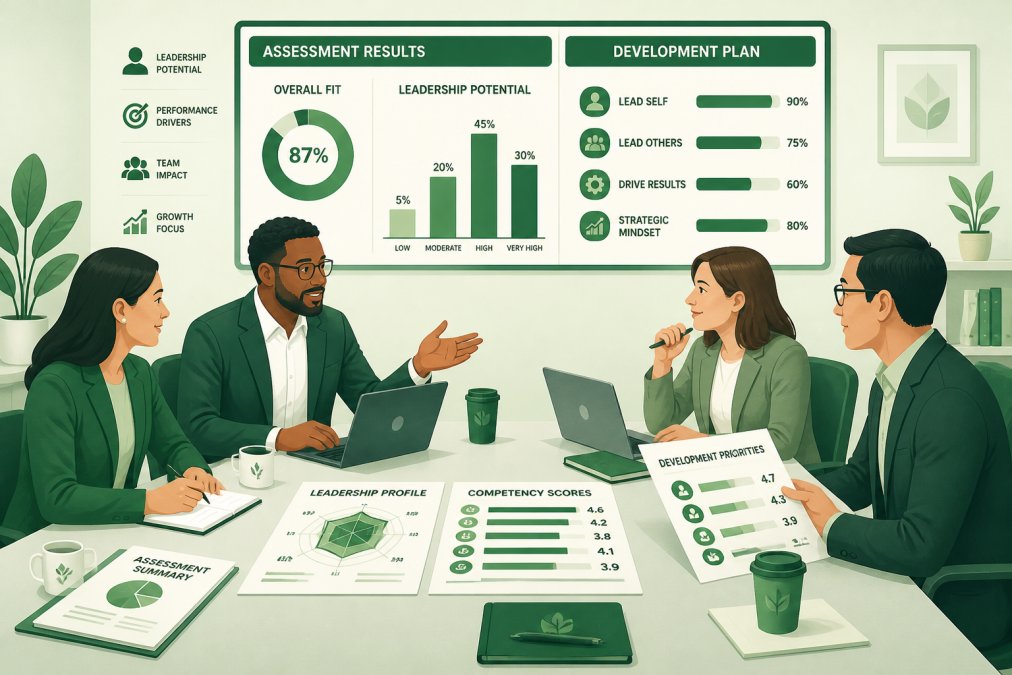
Start by defining the business problem. If you're identifying high-potential talent and surfacing behavioral risks, psychometric assessments like Hogan offer scientific rigor. If you're building team cohesion and want leaders to understand each other's strengths, CliftonStrengths or Zenger Folkman create a strengths-based foundation. If leaders lack authentic presence or struggle with identity and influence, character-driven coaching from Jim Carlough addresses the root problem directly.
For organizations wanting comprehensive development at scale, DDI or Center for Creative Leadership offer research-backed programs with built-in accountability. FranklinCovey works well if you want a structured framework and flexibility in engagement.
Consider these questions:
- What's the actual problem? Identifying talent gaps, building team effectiveness, transforming leadership presence, or scaling capability?
- Who needs development? Individual high-potentials, specific leadership levels, or organization-wide?
- What's your timeline? Six months or a twelve-month transformation?
- What's your budget? Options span from affordable individual assessments to enterprise programs.
- Do you need internal capability? Can you certify coaches internally, or do you need ongoing external support?
- What's your organizational culture? Do leaders respond better to strengths-based approaches, behavioral frameworks, or character-driven development?
The most successful organizations combine assessments, coaching, and development programs in ways that address their specific challenges. A typical approach might involve CliftonStrengths for team building, Hogan for succession assessment, and targeted coaching for high-potential leaders.
Conclusion
The alternatives to Korn Ferry leadership programs reflect a fundamental shift in how organizations approach development. Rather than standardized assessments applied uniformly, leading organizations combine targeted assessments with coaching and development programs that address their specific challenges.
For executives struggling with presence and influence, Jim Carlough's character-driven approach builds the authentic leadership identity that drives engagement and retention. For organizations needing research-backed assessment and scalable programs, DDI and Center for Creative Leadership deliver proven frameworks. For teams building on strengths, CliftonStrengths and Zenger Folkman create positive momentum.
The key is matching the alternative to your actual business problem. Start with a clear definition of what you're trying to achieve, pilot with a smaller group, and measure outcomes consistently. Organizations that do this see leadership development translate to measurable improvements in team engagement, retention, and organizational performance.
Ready to transform how your leaders show up? Explore Jim Carlough's character-driven leadership coaching to see how intentional identity development can move your organization beyond titles to authentic, effective leadership.
Frequently Asked Questions
What makes a leadership assessment alternative better than Korn Ferry?
The best leadership assessment alternative depends on your organization's specific needs. Some alternatives excel at psychometric testing and predictive validity (Hogan, Zenger Folkman), while others focus on strengths-based development (Gallup CliftonStrengths) or character-driven coaching (Jim Carlough). Consider whether you need assessment tools alone, coaching services, or an integrated program. Evaluate the methodology's alignment with your talent strategy, the depth of support provided, and total cost of ownership including implementation and follow-up.
How do I measure leadership development program ROI?
Track metrics that matter to your business: employee retention rates among high-potential leaders, internal promotion rates, time-to-productivity for promoted leaders, and engagement scores. Measure behavioral change through 360-degree feedback before and after the program. Correlate leadership development participation with team performance metrics like retention, productivity, and customer satisfaction. Document cost savings from reduced turnover, replacing a mid-level leader typically costs 50-200% of annual salary. Calculate ROI by dividing total benefits by program cost. DDI reports a 424% ROI in their Forrester study, providing a benchmark for enterprise programs.
What's the difference between psychometric testing and coaching-based leadership development?
Psychometric testing (Hogan, Gallup, Zenger Folkman) provides objective data about personality, strengths, values, and potential derailers, useful for talent selection, succession planning, and identifying development areas. Coaching-based development (Jim Carlough, BetterUp, Torch) focuses on behavioral change, confidence-building, and real-world application through personalized guidance. Many organizations use both: assessment tools identify what to develop, while coaching helps leaders implement change. Character-driven approaches like Jim Carlough's emphasize identity and authentic leadership, complementing traditional assessments with deeper intentional development.
Are boutique leadership coaches like Jim Carlough better than large consulting firms?
Boutique coaches offer personalized attention, deep expertise in specific domains (like character-driven leadership), and often more flexible engagement models. Large firms like DDI and Center for Creative Leadership provide research-backed frameworks, scalable programs for enterprise-wide deployment, and established track records across industries. Boutique coaches excel for emerging leaders needing confidence and presence development. Large firms work better for succession planning, building leadership pipelines, and organizations needing assessment and development at scale. Your choice depends on scope: individual transformation versus organizational capability building.
This article was written using GrandRanker