
How to Stop Micromanaging Your Team
Table of Contents
- Recognize the Signs You're Micromanaging
- Understand Why You Micromanage
- How to Delegate Effectively Without Losing Control
- Set Clear Expectations and Goals
- Use Delegation Templates for Managers
- Tools for Tracking Project Progress Without Hovering
- Rebuild Trust After Micromanagement
- Conclusion
Last Updated: August 13, 2026
Recognize the Signs You're Micromanaging
The first step to stop micromanaging your team is recognizing that you're doing it. Many leaders don't see their own behavior clearly until the damage shows up in team morale, retention, or performance metrics.
Micromanagement shows itself in predictable patterns: constant status updates before they're due, reviewing work multiple times, hovering over decisions your team should make independently, rewriting emails, or attending meetings that don't require your presence. According to research from the Center for Creative Leadership, leaders who micromanage frequently do so because of fear, fear of failure, losing control, or that their team isn't capable. This fear-based management style creates a feedback loop: the more you control, the less autonomy your team has, and the less capable they appear to become.
Watch for these specific warning signs: regularly checking in on tasks before deadlines, team members hesitant to make decisions without approval, thinking "I could do this faster myself," disengaged direct reports looking elsewhere, struggling to delegate beyond routine tasks, or difficulty trusting work will meet your standards. If several resonate, you're likely micromanaging. The good news is that recognizing it is the hardest part.
Understand Why You Micromanage
Understanding your own triggers is essential before you can change the behavior. Most leaders micromanage for one of three core reasons: fear, perfectionism, or unclear expectations.
Fear-based micromanagement usually stems from past experiences, being burned by a team member, rapid promotion without full confidence, or needing to prove yourself in a new role. Perfectionism-driven micromanagement comes from high standards and commitment to excellence, but your definition becomes the only acceptable standard, suffocating your team's ability to develop their own judgment. Unclear expectations create a third type: when goals and decision-making authority aren't explicit, leaders fill the gap by controlling the process.
Jim Carlough's work in leadership development emphasizes that understanding your own identity as a leader, your values, insecurities, and patterns is the foundation for change. When you can name what's driving your micromanagement, you can address it directly. Take an honest inventory: Is it fear, perfectionism, or unclear expectations? Your answer will shape how you approach the rest of this process.
How to Delegate Effectively Without Losing Control
Delegation is the antidote to micromanagement, but it only works if you do it deliberately. The key is to separate outcome accountability from process control. You stay accountable for the result; your team member is accountable for executing the work.

Effective delegation starts with clarity about three things: the outcome you want, the constraints or guardrails, and the authority your team member has to make decisions. Define the outcome in specific terms, not "improve our process" but "reduce onboarding time from 10 days to 5 days." Be explicit about constraints: budget, fixed timelines, and which decisions require your approval versus which they can decide independently. This clarity prevents constant permission-seeking.
Then step back. Resist the urge to check in constantly. Set a check-in schedule and stick to it. Between check-ins, let them work. When you do check in, focus on outcomes and progress toward the goal, not methods. Ask: "Where are we against the timeline?" "What obstacles have you hit?" "What do you need from me?" These questions keep you informed without controlling the process.
Set Clear Expectations and Goals
Vague expectations breed micromanagement. When you're not sure what success looks like, you try to control the process. Clear expectations eliminate that need.
Define goals in outcomes-based terms using specific metrics: revenue targets, customer satisfaction scores, project timelines, quality benchmarks. Clarify what good performance looks like at each stage. For a three-month project, what should be complete by month one? By month two? This gives your team member checkpoints to self-assess and prevents you from hovering.
Expectations also need to include decision-making authority. Which decisions can they make independently? Which require your input? Which are escalations? Make it explicit. One practical approach is a simple decision matrix with three columns: decisions they can make independently, decisions to discuss with you first, and decisions requiring your approval. Share this with your team and update it as they prove they can handle more autonomy.
Use Delegation Templates for Managers
A delegation template ensures you're delegating consistently and completely. It forces you to think through all elements before handing off work, preventing the confusion that leads to micromanagement.
Here's a practical template:
Task: [Specific name of the work]
Outcome: [What success looks like, in measurable terms]
Timeline: [Start date, key milestones, end date]
Constraints: [Budget, resources, fixed parameters]
Decision Authority: [What they can decide independently, what requires your input]
Check-In Schedule: [When you'll meet to review progress]
Success Metrics: [How you'll measure if this was done well]
Questions? [Invite them to clarify before starting]
Walk through it together before handing it off. Ask them to explain back what they're responsible for and what authority they have. This conversation prevents misalignment that would otherwise force you to micromanage. Use this template consistently so it becomes a shared language between you and your team.
Tools for Tracking Project Progress Without Hovering
The right tools let you stay informed about progress without needing to ask constantly. Project management platforms like Asana, Monday.com, or Jira let you see what's in progress, blocked, or complete without constant emails. Set them up so information flows automatically, when your team updates their work status, you see it without asking.
Status reports can work too, but structure them to prevent micromanagement. Try a weekly written update covering: what was accomplished, what's in progress, what's blocked, and what help is needed. This gives you visibility on a regular cadence without constant check-ins.
The important thing is that the tool or process is transparent to both parties. Your team should know what visibility you have and what you're tracking. Transparency prevents the feeling of being watched and builds trust. Consider setting up automated alerts for specific milestones or blockers so you're responding to real problems, not checking in preemptively. The goal is to shift from active monitoring to passive visibility.
Rebuild Trust After Micromanagement
If you've been micromanaging your team, trust is damaged. Rebuilding it takes time and consistent action.
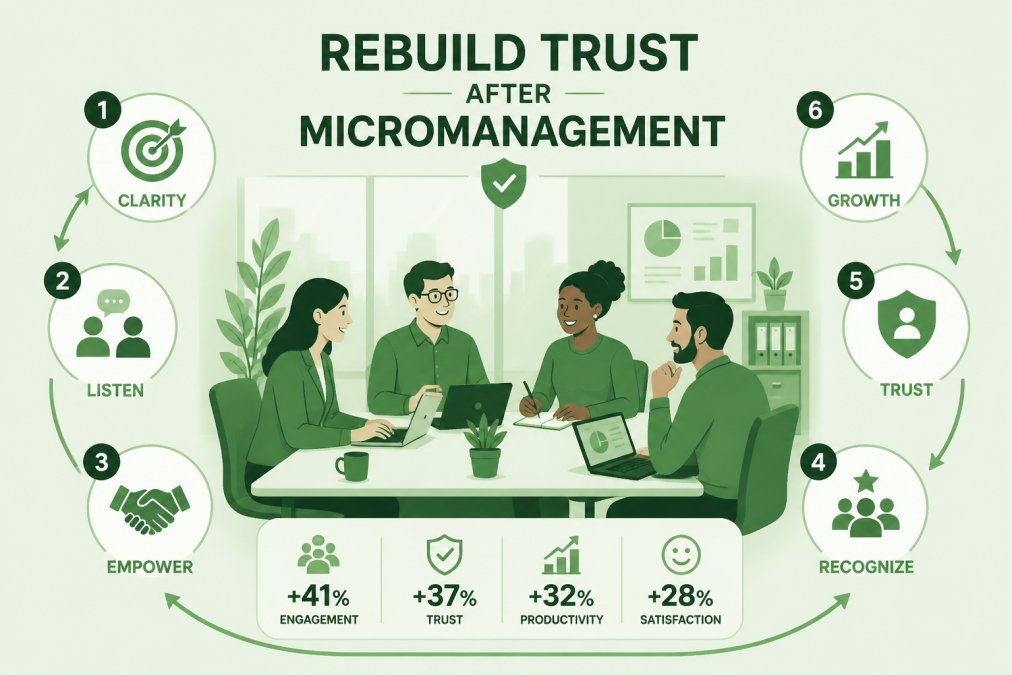
Start by acknowledging the pattern. Your team needs to know you see the problem and are committed to changing it. Something like: "I've realized I've been too hands-on with how you do your work. I want to give you more room to make decisions and own your projects. I'm going to step back, and I want your help if I slip back into old patterns." This shows self-awareness and gives your team permission to call you out if you micromanage again.
Follow through with action. The only way to rebuild trust is to actually give autonomy and let your team succeed or fail with it. If you say you're stepping back but jump in the first time something goes wrong, you've confirmed you don't trust them. Tolerate some discomfort. Your team might do things differently than you would. As long as it meets the outcomes you defined, let it stand.
Rebuild trust by being visible about your confidence in them. In meetings, let them present their own work. Give them credit publicly. Ask for their input on decisions. These actions signal that you trust their judgment. According to research from Harvard Business Review on trust in organizations, leaders who rebuild trust do so by being consistent, transparent, and willing to be vulnerable. Be patient with the process. Trust doesn't rebuild in a week, but if you're consistent, your team will believe the change is real.
Conclusion
Micromanagement is a pattern, not a personality trait. It can be changed. The path forward starts with recognizing the behavior, understanding what's driving it, and then deliberately shifting how you delegate, set expectations, and trust your team. On the other side of that discomfort is a team that's more engaged, more capable, and more loyal.
If you're struggling to break the micromanagement cycle, Jim Carlough's executive coaching and leadership development programs are designed exactly for this. With over 30 years of experience helping leaders shift from control-based to character-driven leadership, Jim works with executives to build the confidence, clarity, and influence that allows you to lead through trust rather than oversight. Learn more about Jim Carlough's leadership coaching or BOOK JIM TO SPEAK to explore how character-driven leadership transforms team dynamics and organizational culture.
| Micromanagement Signal | Impact on Team | How to Address It |
|---|---|---|
| Constant status updates before deadlines | Reduced autonomy, lower engagement | Set clear check-in schedule and stick to it |
| Reviewing work multiple times | Slowed decision-making, frustration | Define outcome, then step back |
| Hovering over decisions | Team hesitates to act independently | Clarify decision authority upfront |
| Rewriting team communications | Loss of voice and ownership | Review first drafts, then let them send |
| Attending unnecessary meetings | Perception of distrust | Let team run meetings independently |
Frequently Asked Questions
What are the signs that you are a micromanager?
Common signs include requiring approval on every decision, checking in constantly on task progress, rewriting team member work, hovering during meetings, and focusing on how tasks are done rather than outcomes. You may also notice your team hesitates to make decisions or asks permission for routine work. If direct reports seem disengaged or frequently mention feeling untrusted, these are signals that your management style has shifted toward micromanagement.
How do I build trust with my direct reports after micromanaging?
Start by acknowledging the pattern directly, don't ignore it. Explain what you're working to change and why. Give your team genuine autonomy on smaller projects first, then expand responsibility as trust rebuilds. Follow through consistently on stepping back, even when it's uncomfortable. Ask for feedback on your progress and be open to hearing it. Trust rebuilds over time through repeated demonstrations that you respect their competence and judgment.
What's the difference between micromanaging and effective oversight?
Effective oversight focuses on outcomes, deadlines, and strategic alignment. You set clear expectations, check progress at agreed intervals, and trust team members to manage their own process. Micromanagement focuses on controlling how work gets done, requiring daily check-ins, dictating methods, and second-guessing decisions. The key distinction: oversight asks 'Did you hit the target and timeline?' Micromanagement asks 'Are you doing it my way, right now?'
How can managers transition from task-oriented to results-oriented leadership?
Define success by measurable outcomes, not activities. Instead of tracking what your team is doing hour-by-hour, establish KPIs and review them weekly or bi-weekly. Give team members decision-making authority within their scope. Replace 'show me your work' conversations with 'what results did you achieve?' discussions. This shift requires you to focus on coaching and removing obstacles rather than directing tasks. It takes practice, but the payoff is higher autonomy and better team morale.
This article was written using GrandRanker