Executive Coach Vs Leadership Consultant: Which Fits?
Hiring the wrong practitioner for a leadership challenge is an expensive mistake. It stalls organizational momentum and frustrates your best people. When you face a real gap in performance or culture, the distinction between an executive coach vs leadership consultant determines whether you solve a systemic problem or transform an individual leader. Confuse the two and you end up with misallocated budgets and development initiatives that never touch the root cause of stagnation.
Defining the Difference Between Coach and Consultant
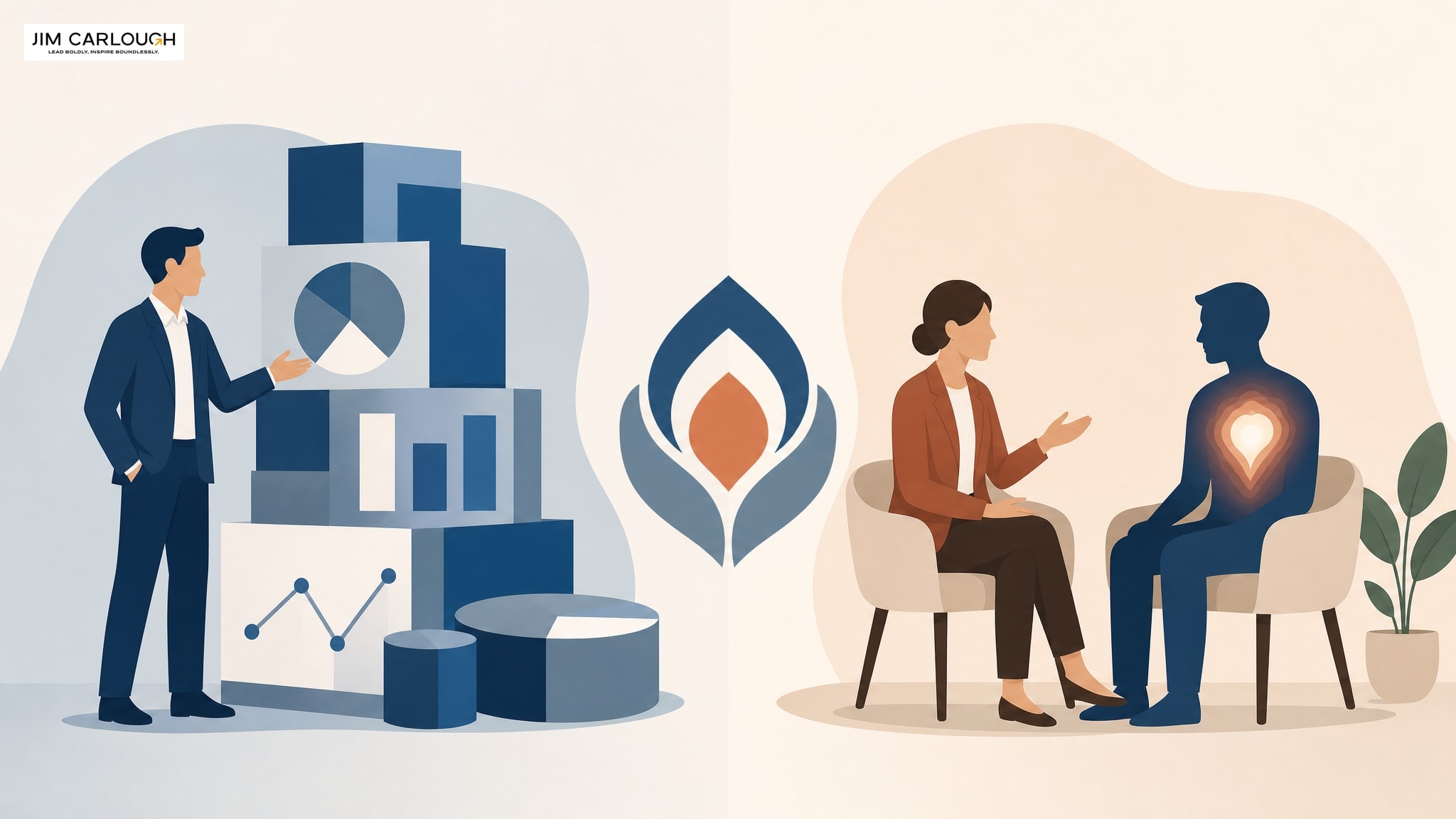
The difference between coach and consultant comes down to where they put their attention and what they're actually trying to change in your organization. A leadership consultant diagnoses organizational problems, analyzes data, and prescribes specific solutions for structural or operational gaps. The consultant is the expert who delivers answers. An executive coach does something else entirely: they ask questions that help a leader rebuild their internal narrative and self-concept, so the leader generates their own sustainable solutions.
This distinction matters because technical competence often masks deeper identity conflicts that no amount of external advice can resolve.
Consultants bring specialized knowledge to implement new systems, optimize workflows, or restructure teams based on industry best practice and objective analysis. Coaches work with the leader's internal operating system instead, the beliefs, values, and self-perceptions that dictate how someone shows up regardless of what the org chart says. You hire a consultant when you need a roadmap. You hire a coach when the leader holding the map can't navigate the terrain because of who they believe they are.
When to Hire an Executive Coach for Identity-Based Growth
Coaching becomes the necessary intervention when a leader's internal narrative limits their external impact, even though they're clearly competent and intelligent. Sustainable behavioral change requires addressing who the leader believes they are, not just what they do. Actions align with identity, not aspiration. If a senior manager understands delegation intellectually but still micromanages under stress, the bottleneck isn't a skill deficit. It's an unresolved identity conflict around control and trust.
Signs a leader needs identity-based coaching: recurring interpersonal friction, an inability to step into expanded authority, or consistent feedback about their presence that contradicts how they see themselves.
Three decades of working with executives has taught me that lasting change starts when leaders reconstruct their professional identity, not just their habits. Leaders often come looking for consulting on team alignment issues, only to discover the root cause is their own unresolved identity conflict around authority, something no organizational redesign could ever fix. This is exactly when executive leadership coaching for C-suite professionals proves more valuable than tactical advice. It targets the internal architecture that governs all external behavior.
When Leadership Advisory Services Solve Structural Gaps
Leadership advisory services are the right choice when the obstacle is systemic rather than personal, and it requires expertise the current leadership team doesn't have. Scenarios that call for consulting: designing new organizational structures after rapid growth, implementing performance management systems across business units, or aligning disparate teams during a merger. These engagements solve structural problems efficiently. What they rarely do is transform individual leadership presence or reshape how executives relate to power and responsibility.
A consultant can build a perfect succession planning framework, and the initiative will still fail if the CEO's identity stays tied to being the indispensable decision-maker who can't release control.
Engage consulting when the problem is definable, measurable, and solvable through process redesign, market analysis, or technical implementation. The deliverable is usually a report, a system, or a strategy, and the organization executes it with its existing leadership capacity. Know this boundary and you avoid the common error: expecting a consultant to fix a leader's relationship with vulnerability, or expecting a coach to design your compensation architecture.
Coaching vs Consulting for Leaders: A Decision Framework
Choosing between coaching vs consulting for leaders means matching your current challenge to the right practitioner, based on whether the bottleneck is personal transformation or organizational design. Start by asking whether the outcome you want depends mainly on changing how individuals think and feel, or on changing how work flows through the organization. If it's both, figure out which constraint is binding right now. Solve the secondary problem first and you've wasted resources while the primary blocker sits there untouched.
Here's a practical way to check fit before you commit budget. If multiple competent leaders struggle with the same issue, the problem is probably systemic, and that calls for consulting. If one capable leader keeps failing in similar situations despite adequate support and clear expectations, the issue is probably identity-based, and that calls for coaching. HR and L&D leaders who apply this lens avoid the costly habit of running the same solution against fundamentally different problems, which is how you make sure development spending actually moves the needle.
Why Leadership Identity Is the Missing Link in Development
Most leadership development fails because it targets visible behaviors without reshaping the identity that generates those behaviors in the first place. Training programs teach skills that leaders understand intellectually but can't embody under pressure, because their self-concept hasn't caught up to the new demands. Treat identity work as the foundation and both coaching and consulting get more effective over time: leaders with coherent identities implement structural changes with more fidelity and hold onto behavioral shifts long after the engagement ends.
Corporate leadership development programs work when they treat identity formation as the precursor to skill application.
Skip this foundational layer and organizations produce leaders who can articulate the right vision but can't inhabit it authentically. That breeds cynicism and erodes trust throughout the ranks. Identity-based development starts from the premise that leadership isn't just a set of competencies to acquire. It's a way of being that has to be built and integrated. Without that, even well-designed corporate leadership development programs produce diminishing returns, because participants revert to familiar patterns the moment external accountability fades.
Integrating Coaching and Consulting in Corporate Leadership Development
Mature organizations sequence or layer both modalities, addressing system and self at the same time instead of treating coaching and consulting as mutually exclusive. Integration might mean bringing in a consultant to redesign team structures while coaching the leaders who have to inhabit those new roles with a different mindset. This layered approach heads off two common failures: structural changes collapsing under leadership resistance, or coaching gains evaporating because the system keeps punishing the new behavior.
Consider introducing the identity framework at scale through keynote speaking on leadership identity before committing to intensive coaching or consulting, so stakeholders develop shared language and buy-in first. Sequencing matters. Sometimes identity work has to precede structural consulting so leaders can actually receive and implement recommendations without getting defensive. Other times, a consulting engagement uncovers identity gaps that only targeted coaching can address, which is when the two disciplines become genuinely complementary rather than competing for the same budget.
Choosing a Practitioner Rooted in Real Leadership Experience
Selecting the right partner means looking past credentials to ask whether this practitioner has actually navigated the leadership challenges your executives face now. Academic certifications and methodology knowledge matter, but they can't substitute for the wisdom that comes from sitting in the executive chair and carrying the weight of consequential decisions. Leaders detect authenticity fast, and they disengage from practitioners whose authority comes from theory rather than lived experience in complex organizations.
Therapy addresses internal trauma; coaching addresses external leadership behavior. Conflate the two and you undermine both.
Your selection criteria should include evidence that the practitioner understands leadership identity as distinct from therapy, consulting, or mentoring, and can connect identity work to tangible business outcomes. Ask candidates to describe situations where they helped leaders through identity transitions like the ones your organization faces, and listen for specifics rather than generic frameworks. The right practitioner carries enough real-world scar tissue to earn trust, while keeping enough professional distance to drive real transformation instead of handing out comfortable validation.
Frequently Asked Questions
What is the going rate for an executive coach?
Executive coaching fees vary significantly based on the coach's experience, the engagement length, and the seniority of the leader being coached. Senior practitioners with decades of corporate experience typically charge premium rates that reflect their ability to navigate complex identity and organizational dynamics. Always evaluate pricing against the specific outcomes you need rather than comparing hourly rates alone.
Is an executive coach worth the investment?
Executive coaching delivers measurable ROI when the leader's growth directly impacts organizational performance and the challenge is rooted in identity or behavioral patterns rather than structural gaps. The investment pays off when leaders make sustained shifts in how they operate, leading to better retention, stronger team performance, and more effective execution of strategic priorities. Coaching is not worth it if the real problem is systemic and requires consulting instead.
What is the difference between executive and leadership coaching?
Executive coaching specifically targets C-suite and senior leaders navigating high-stakes identity transitions, strategic ambiguity, and organizational complexity unique to top-tier roles. Leadership coaching serves emerging and mid-level leaders developing foundational management capabilities and professional identity. The distinction matters because the stakes, confidentiality requirements, and identity work differ substantially between these populations.
How long does identity-based coaching take to show results?
Identity-based coaching typically requires six to twelve months for meaningful integration, as reconstructing professional self-concept cannot be rushed like skill acquisition. Early indicators such as increased self-awareness and shifted language may appear within weeks, but sustainable behavioral change under pressure takes longer to solidify. Organizations expecting quick fixes should reconsider whether coaching is the right intervention for their timeline.