
Best Leadership Development Programs 2026
Table of Contents
- Quick Comparison: Top Leadership Development Programs
- How We Evaluated Leadership Development Programs
- Jim Carlough: Character-Driven Leadership Development
- DDI Leadership Development Solutions: Research-Backed Scalability
- Leadership Development for Emerging Leaders
- Leadership Development Program Duration and Format Options
- Best Practices for Leadership Training Implementation
- Measuring ROI and Post-Program Implementation Support
Last Updated: August 24, 2026
Quick Comparison: Top Leadership Development Programs
The difference between a transformative leadership program and an expensive waste of time often comes down to one factor: does it change how leaders actually show up in real conversations? The best programs focus on identity and character, not just competencies and frameworks.
| Program | Best For | Core Approach | Format | Investment |
|---|---|---|---|---|
| Jim Carlough | Leaders seeking character-driven transformation | Identity development, human connection | Executive coaching, keynote speaking, programs | Custom pricing |
| DDI Leadership Development Solutions | Enterprise-scale programs with measurable ROI | Research-backed assessment and customized solutions | Multi-modal (live, microlearning) | Contact for quote |
| FranklinCovey All Access Pass | Emerging leaders and managers | Habit-based learning, self-paced flexibility | Live sessions + on-demand courses | $136-$250/seat/year |
| Harvard Business School PLD | High-potential executives preparing for C-suite | Case method, executive coaching, immersive | Four intensive modules over six months | ~$81,000 |
| Dale Carnegie Leadership Training | Foundational communication and human relations | Trust-building, practical communication | In-person, virtual, self-paced | $284-$2,500 per course |
| Korn Ferry Leadership Development | Organizations needing data-driven transformation | AI-driven assessments, personalized coaching | Customized packages | Contact for quote |
| Gallup Leadership Development | Strengths-based development | CliftonStrengths framework | Coaching, workshops, certifications | Contact for quote |
| Emergenetics Leadership Development | Teams needing cognitive diversity insights | Thinking and behavioral preference mapping | Workshops, mobile app tools | Contact for quote |
| Center for Creative Leadership (CCL) | Leaders at all levels seeking research-backed programs | Practical skill development, 360 assessments | In-person, online, customized | Contact for quote |
| American Management Association (AMA) | Managers seeking practical skill development | Strategic thinking, emotional intelligence | In-person, live online courses | Contact for quote |
How We Evaluated Leadership Development Programs
We evaluated programs on eight core criteria: research backing and methodology, customization versus off-the-shelf approaches, measurable ROI and behavioral change, post-program implementation support, format flexibility, depth for emerging leaders, character and identity development, and cultural fit with industry expertise.
The best programs rest on decades of research. DDI has over 50 years of organizational psychology research (ddiworld.com). Gallup's strengths-based model is built on millions of data points. Harvard's case method has trained business leaders for over a century (hbs.edu).
Programs allowing deep customization to your industry and culture rank higher than rigid curricula. The best programs track behavioral change through 360-degree feedback or measure business outcomes like retention and engagement. DDI reports clients seeing 424% ROI, a signal that change is possible and trackable (ddiworld.com).
Real change happens after the program ends. Programs that include post-program coaching, peer accountability, or implementation support rank higher than those that hand you a certificate and wish you luck. The best programs blend live facilitation, microlearning modules, AI-powered coaching, and self-paced content.
Most enterprise programs focus on C-suite executives. Emerging leaders, high-potential mid-level managers preparing for director roles, often get generic "leadership basics." Programs offering genuine depth for this cohort signal they understand the real bottleneck: the transition from individual contributor to people leader.
The best programs recognize that leadership is fundamentally about identity. How you see yourself as a leader shapes every decision you make. Programs with genuine expertise in your industry or flexibility to adapt are worth the premium.
Jim Carlough: Character-Driven Leadership Development
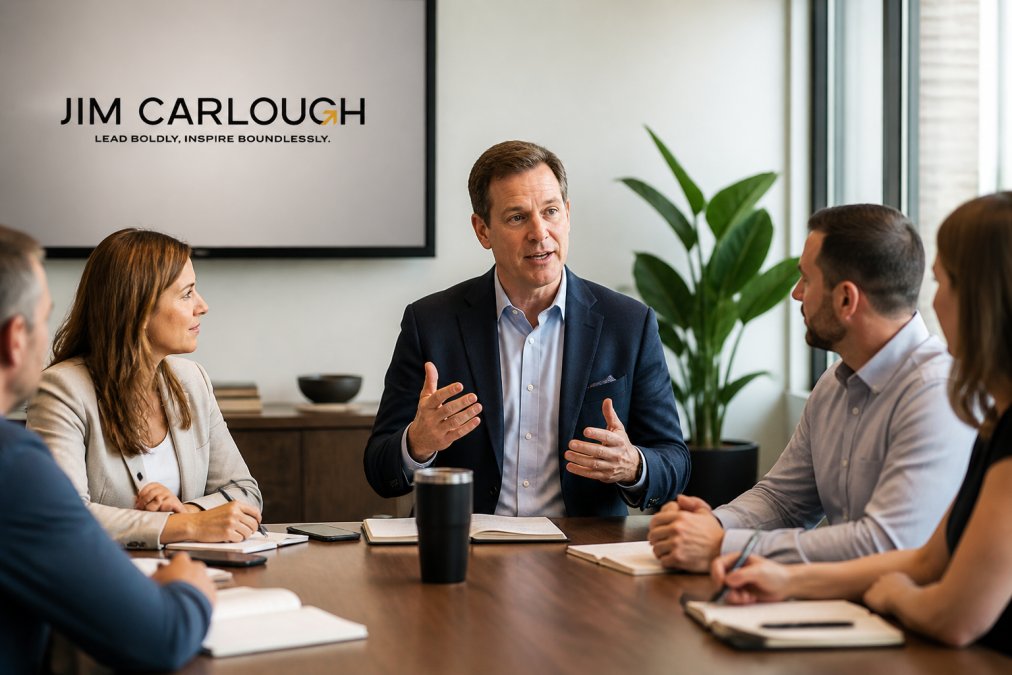
Jim Carlough starts with a premise most programs skip: leadership isn't about acquiring more competencies. It's about developing your identity as a leader, who you actually are when you're under pressure, when you don't have all the answers, when your team is watching to see if you'll stand firm.
With over 30 years of enterprise transformation experience across healthcare, technology, and professional services, Carlough addresses a critical gap in 2026. Automation and AI are rewriting what technical leadership means. Younger teams demand authenticity, not authority. Remote and hybrid work has stripped away the theater of leadership. You need genuine influence built on character.
Jim Carlough provides executive coaching for individual leaders, keynote speaking, and developmental programs for teams and leadership cohorts. The coaching focuses on building confidence, clarity, and influence through intentional identity development. Most corporate programs treat leadership as a skill problem. Carlough treats it as an identity problem. If your VP role still doesn't feel like "yours" after two years, that's an identity issue, not a skills gap.
Best for: Leaders who know they have capability but don't feel like they belong yet. Organizations where the issue is confidence, presence, and clarity of identity rather than competency. Teams preparing for significant transformation.
DDI Leadership Development Solutions: Research-Backed Scalability
If you need to develop 50 or 500 leaders with consistency and measurable outcomes, DDI sits at the top for enterprise-scale programs.
DDI's model rests on a simple principle: leadership development must be evidence-based and measurable. Over 50 years, they've built research into what actually moves the needle. Their clients report 424% ROI, signaling that transformation is possible and trackable.
DDI builds separate tracks for frontline managers, mid-level leaders, and C-suite executives. A frontline manager's biggest issue might be delegation and building trust. A C-suite executive's challenge might be navigating board dynamics. One program doesn't solve both.
Their multi-modal approach combines live immersive sessions with targeted microlearning, assessments, and tools. DDI customizes content to align with your organizational brand, culture, and specific challenges. They track behavioral change through 360-degree feedback and measure business outcomes like retention and engagement.
Best for: Enterprise organizations needing to scale leadership development across multiple levels and geographies. Companies where you need consistent measurement and can justify investment based on specific business outcomes.
Leadership Development for Emerging Leaders
This is where most programs fail. Emerging leaders, high-potential managers preparing to step into director roles, often get a lighter version of C-suite content. That's a mistake.
The transition from individual contributor to people leader is the hardest leadership transition most people make. You're suddenly responsible for people's careers, compensation, and performance. You're no longer judged on what you personally accomplish, but on what your team accomplishes. That identity shift breaks a lot of people.
Supporting emerging leaders well means recognizing their distinct challenges: building credibility quickly, learning delegation without losing control, developing presence and influence while feeling like imposters, and learning language for difficult conversations they've never had.
FranklinCovey's All Access Pass includes content specifically for emerging leaders and new managers. Center for Creative Leadership offers "Maximizing Your Leadership Potential" for first-level leaders. Gallup's coaching model can be tailored to emerging leaders' specific challenges.
Emerging leaders need permission to be uncertain, peer connection with other leaders at their level, and specific language for difficult conversations: how to tell a high performer they're not getting promoted, how to push back on your boss respectfully, how to make decisions without all the information.
Best for: High-potential managers in their first director role or preparing for it. Organizations with strong succession planning who want to invest in the next generation before they leave for competitors.
Leadership Development Program Duration and Format Options
There's no single right answer to how long a program should be or what format it should take. It depends on your challenge, budget, and leaders' capacity.
Harvard's Program for Leadership Development runs four intensive modules over six months. This works if you need deep transformation and can pull leaders away from their day job. The advantage: immersion creates breakthrough moments. The disadvantage: it's expensive, time-consuming, and disruptive.
Most modern programs use blended formats: a few days of in-person facilitation, followed by weeks of microlearning modules, coaching, and peer work. DDI and FranklinCovey both use this model. It's more flexible and allows leaders to integrate learning into actual work.
FranklinCovey's All Access Pass ($136-$250 per seat annually) gives unlimited access to live sessions, on-demand courses, and tools. Jim Carlough's model is primarily coaching-based, customized to individual leaders' challenges. This works if you have specific leaders needing deep transformation.
Are your leaders' challenges individual (specific leaders struggling with presence and confidence) or systemic (your entire leadership culture needs to shift)? Individual challenges call for coaching. Systemic challenges call for programs that cascade across multiple levels with peer cohorts and organizational reinforcement.
Best Practices for Leadership Training Implementation
Without deliberate implementation support, behavioral change from leadership programs fades within 30 days. Leaders go back to old habits because the environment reinforces them and nobody's holding them accountable to new behaviors.
Set clear expectations about what will change and why it matters before the program begins. Have leaders articulate specific behaviors they want to shift. Have their managers understand what's coming and commit to supporting the change.
The best programs include peer cohorts that continue meeting after formal training ends. Monthly peer accountability groups where leaders share progress, obstacles, and support each other are often more powerful than individual coaching.
Instead of satisfaction surveys, use 360-degree feedback before and after the program. Track retention of high performers on those leaders' teams. Measure engagement scores. Behavioral change is measurable if you design for it.
If a leader learns about emotional intelligence but returns to a culture rewarding command-and-control leadership, the program loses. You need organizational signals reinforcing what was learned: adjusted performance reviews emphasizing leadership behaviors, senior leaders modeling new approaches, or shifted promotion decisions.
Allocate resources for coaching during the critical 90 days after the program, for peer cohort facilitation, for reinforcement communications, and for measurement.

Measuring ROI and Post-Program Implementation Support
The question that stops most leadership development initiatives: "How do I justify this investment to my CFO?"
Leadership development ROI typically shows up in retention (especially of high performers), engagement, and performance. If a strong leader leaves because they didn't feel developed, that's a $200K+ replacement cost. If developing your emerging leaders reduces turnover by 10%, that's millions in avoided replacement costs.
Start with a baseline. Before the program, measure retention rates for leaders entering the program and their direct reports. Measure engagement scores and business metrics relevant to your industry. After the program, measure the same metrics at 6, 12, and 18 months. The difference is your ROI.
DDI reports clients seeing 424% ROI. That depends on implementation, organizational support, and the specific metrics you're tracking, but it signals transformation is possible and measurable.
Without post-program support, behavioral change fades. Leaders who receive coaching after a program are significantly more likely to sustain behavioral change than those who don't. The investment in post-program support typically pays for itself through improved retention alone.
Ask about post-program support. How do they help you measure behavioral change? What coaching or accountability structures do they include after the program ends? How do they help you build organizational reinforcement? The answers often matter more than the program itself.
The best leadership development program isn't the most prestigious or expensive. It's the one that matches your specific challenge, includes genuine post-program implementation support, and measures what actually changed.
If you're a leader who feels like you don't belong yet despite years in your role, or if you're building a leadership pipeline and need character-driven transformation at scale, Jim Carlough's approach offers something most programs don't: focus on identity development over competency acquisition. With over 30 years of enterprise transformation experience across healthcare, technology, and professional services, Carlough works on building the confidence, clarity, and influence that transforms how leaders show up in real conversations. Whether through executive coaching, keynote speaking, or developmental programs, the focus remains on character-driven leadership development. Reach out to explore how this could address your specific organizational challenge.
Frequently Asked Questions
What are the most important factors to consider when choosing a leadership development program?
The best leadership development programs align with your organization's strategic goals, address specific skill gaps, and fit your budget and timeline. Key factors include program format (in-person, virtual, or blended), duration, assessment methods, coaching availability, and post-program support. Consider whether the program emphasizes soft skills like emotional intelligence and communication alongside technical competencies. Verify that the provider offers measurable outcomes and can demonstrate ROI through case studies or client testimonials relevant to your industry.
How do I measure the ROI of a leadership development program?
Effective ROI measurement starts before the program begins. Establish baseline metrics: employee engagement scores, retention rates, promotion velocity, and team productivity. Track behavioral changes through 360-degree assessments pre- and post-program. Monitor business outcomes like improved retention, faster time-to-promotion, and enhanced team performance. Most quality programs provide a framework for measuring ROI; DDI, for example, reports clients achieve 424% ROI. Set clear success criteria upfront with your program provider so expectations align and results can be tracked systematically.
What's the difference between character-driven leadership and traditional leadership development?
Character-driven leadership development focuses on building authentic identity and human connection rather than just titles and competencies. Traditional programs often emphasize technical skills and management functions. Character-driven approaches, like those offered by Jim Carlough, help leaders develop confidence, clarity, and influence by addressing who they are as leaders, not just what they do. This approach supports genuine behavioral change and stronger team engagement because it builds leadership from internal identity outward, creating lasting transformation rather than surface-level skill acquisition.
Are online leadership development programs as effective as in-person training?
Modern blended programs combine the strengths of both formats. In-person immersive sessions build relationships and allow for experiential learning; virtual options offer flexibility and accessibility. Research shows that blended learning, combining live facilitated workshops with self-paced online content and coaching, delivers strong results when designed well. The effectiveness depends on program quality, participant engagement, and post-program implementation support. Programs like FranklinCovey and DDI offer both formats; choose based on your team's learning preferences, scheduling constraints, and the complexity of skills being developed.
This article was written using GrandRanker