
BlOG
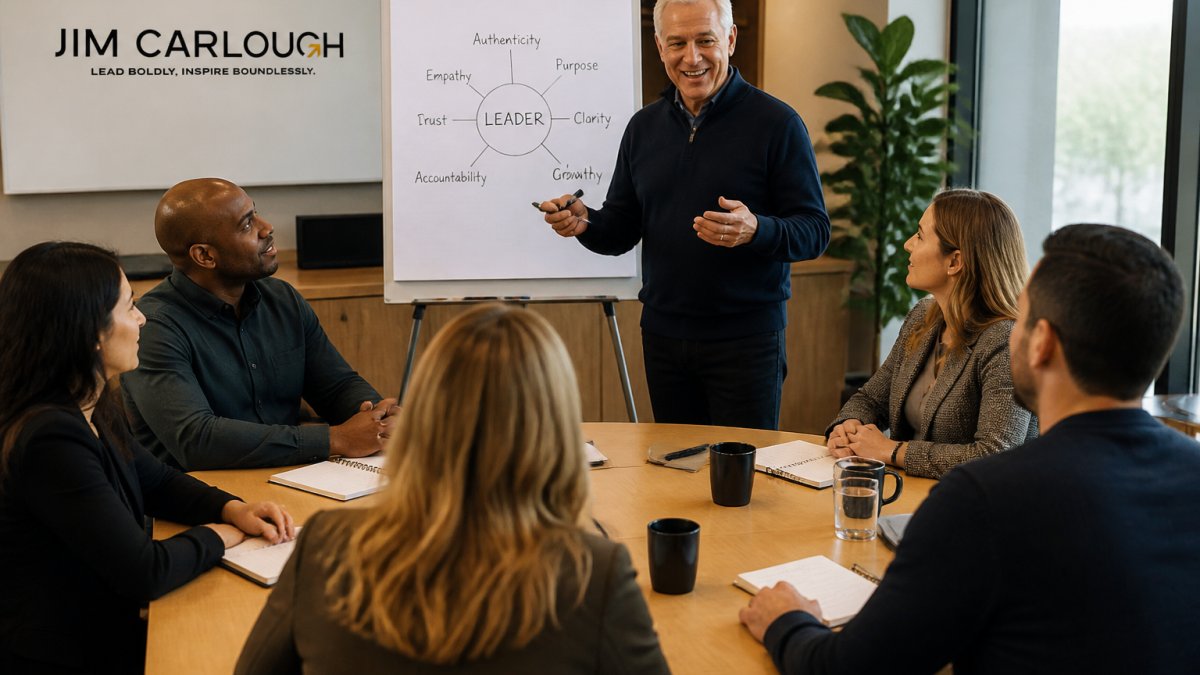
Top 10 Authentic Leadership Development Programs
Table of Contents
- What Makes a Leadership Development Program Authentic
- Quick Comparison: Top 10 Authentic Leadership Programs
- 1. Jim Carlough: Character-Driven Leadership Development
- 2. Center for Creative Leadership (CCL)
- 3. Dale Carnegie Training
- 4. FranklinCovey
- 5. MAP Program and MAP Accelerated
- 6. Kapable
- What About the Other Programs in the Top 10?
- How to Choose: Program Duration, Cost, and Fit
- Frequently Asked Questions
Last Updated: October 4, 2026
What Makes a Leadership Development Program Authentic
The top 10 authentic leadership development programs share one trait: they develop the person, not just the position. Authentic leadership development is the practice of building self-awareness, values clarity, and character alongside management skills, so leaders act consistently whether or not anyone is watching.

Most programs fail leaders in the same way. They teach tactics (how to run a meeting, how to give feedback) without touching the identity underneath. Leaders finish the workshop, return to the same team, and default to the same behaviors within weeks.
Authenticity, by contrast, starts with self-awareness and personal values. It asks a harder question: who are you when the pressure is on?
Our Selection Criteria and Ranking Methodology
We scored each program on five factors: authenticity focus, evidence of outcomes, delivery format, cost transparency, and fit by career stage. We weighted authenticity focus highest because it is the hardest thing to fake and the most common gap in conventional training.
Two limitations matter. First, most providers publish limited outcome data, so we relied on stated methodology and format rather than verified results. Second, pricing is rarely public; where providers do not disclose tuition, we say so rather than guess.
Quick Comparison: Top 10 Authentic Leadership Programs
| Program | Best For | Format | Pricing |
|---|---|---|---|
| Jim Carlough | Character-driven leaders | Coaching, keynotes, programs | Contact for quote |
| Center for Creative Leadership | Multi-level organizations | Research-based cohorts | Contact for pricing |
| Dale Carnegie Training | Communication skills | Workshops, cohorts | Contact for pricing |
| FranklinCovey | Organizational habits | Workshops, licensed content | Contact for pricing |
| MAP Program | Senior executives | Immersive training | Contact for pricing |
| Kapable | New managers | Structured training | Contact for pricing |
1. Jim Carlough: Character-Driven Leadership Development
Jim Carlough is a leadership strategist and author with over 30 years of experience in enterprise transformation. His approach treats leadership as an identity to develop, not a title to earn. That distinction is the whole point.
Engagements include executive coaching, keynote speaking, and developmental programs built on a proprietary six foundational pillars of leadership. The focus lands on confidence, clarity, and influence, plus human skills like empathy and connection.
Pros:
- 30+ years of leadership experience
- Explicit focus on character over titles
- Deep enterprise transformation background
Cons:
- Pricing requires a direct quote
- Best suited to organizations ready for cultural work, not quick fixes
2. Center for Creative Leadership (CCL)
CCL is a nonprofit leadership research and education organization that has run open-enrollment and custom programs for decades. Its catalog spans frontline managers through senior executives, and its research arm publishes widely cited work on leadership development, which is why it appears in nearly every credible roundup. Beyond the theoretical frameworks provided by such institutions, the practical ability to influence diverse stakeholders through commanding a room remains a defining hallmark of effective executive presence.
Approach: CCL's programs lean on assessment, feedback, and cohort-based learning rather than lecture. Participants typically complete pre-work assessments, attend a multi-day session, and leave with a development plan tied to on-the-job action.
Formats: Open-enrollment cohorts at CCL campuses, custom programs delivered on-site for organizations, and virtual cohorts. Duration ranges from a few days to multi-week experiences.
Best for: Organizations that want one provider to serve several leadership levels, and leaders who value a research-backed brand on their development record.
What to verify: Specific program curriculum, cohort dates, and total cost. CCL does not publish tuition for most programs, so a consultation is required. Ask whether assessment instruments, coaching sessions, and follow-up are included or billed separately.
CCL leadership programs overview
3. Dale Carnegie Training
Dale Carnegie is one of the most recognized names in leadership training, built around communication, relationships, and influence. For leaders whose gap is presence in the room, that focus is a direct hit.
4. FranklinCovey
FranklinCovey pairs leadership development with organizational habits and licensed content that companies can run internally. That makes it a strong fit for enterprises wanting consistency across many teams.
5. MAP Program and MAP Accelerated
MAP Consulting describes both the MAP Program and MAP Accelerated as executive leadership programs emphasizing immersive training. Immersion compresses learning time by removing leaders from daily distractions.
Both options suit executives who want intensity over a long, spread-out schedule. Curriculum details and pricing require a direct conversation with the provider.
6. Kapable
Kapable appears in roundups of leadership training for new managers, which is a smart niche. First-time managers form habits fast, and those habits harden.
For emerging leaders, pair any training with self-awareness exercises: values inventories, feedback reviews, and structured reflection. The Harvard Business Review on leadership development has long argued that experience plus reflection, not coursework alone, builds leaders.
What About the Other Programs in the Top 10?
| Program | What We Know | What to Verify |
|---|---|---|
| Alchemist | Listed in leadership-training roundups | Program scope, pricing |
| CrossKnowledge | Named as a training provider | Curriculum, outcomes |
If a provider cannot show you outcomes, treat that as your answer.
How to Choose: Program Duration, Cost, and Fit
Most top-10 lists stop at descriptions. This section is the buyer's guide the rest of the internet skips: how to match a program to your audience, your budget, and the outcome you actually need to see.
Match the program to the leader
- Emerging and first-time managers: Prioritize programs with structured management mechanics (delegation, feedback, one-on-ones) plus a self-awareness component. Shorter cohorts of a few weeks work well. Kapable and Dale Carnegie fit here.
- Mid-level managers: Look for cohort-based programs that combine assessment, peer learning, and on-the-job application. CCL and FranklinCovey serve this tier well.
- Senior executives: Choose immersive or coaching-heavy engagements where the work is confidential and peer-level. MAP Program and MAP Accelerated, plus executive coaching, fit here.
- Women leaders and underrepresented groups: Ask providers directly about affinity cohorts. Many run them but do not feature them on the main program page.
- Whole teams or organizations: Favor providers who can deliver consistently across levels, such as CCL or FranklinCovey, and budget for internal reinforcement.
Delivery format and time commitment
- In-person immersive: Highest intensity, fastest insight, hardest to schedule. Typically multi-day.
- Cohort-based (in-person or virtual): Balances depth and logistics. Often runs several weeks to several months.
- Self-paced or licensed: Most scalable, least transformative on its own. Best paired with coaching or peer accountability.
- One-on-one coaching: Most personalized, highest cost per leader, best for executives and succession candidates.
Cost and what to ask for
Most providers, including Jim Carlough, quote pricing based on scope, group size, and format, so ask for a written quote covering facilitation, materials, assessments, and follow-up. When comparing quotes, normalize them: cost per participant, cost per contact hour, and whether follow-up coaching is included. SHRM guidance on leadership development notes that development spending pays off when tied to clear business outcomes, so tie your budget request to a specific behavior you intend to change.
Evidence and measurement
Ask every provider three questions:
- What outcomes do you measure, and over what follow-up period?
- Can you share references from organizations similar to ours?
- How do you handle leaders who do not improve?
A practical selection checklist
- Define the behavior you want to change
- Confirm the program addresses identity, not just tactics
- Match the format to the leader's level and schedule
- Ask for outcome data or references
- Get total cost in writing, including follow-up
- Plan how you will measure change 90 days out
Frequently Asked Questions
What are the top-rated authentic leadership programs?
The strongest programs combine self-awareness work with practical skill-building. Jim Carlough's character-driven coaching, the Center for Creative Leadership, Dale Carnegie Training, and FranklinCovey all appear in leadership-training roundups. Each serves a different audience: CCL works across executive, manager, and frontline levels, while Jim Carlough focuses on identity and influence for mid-level to senior leaders. Compare delivery format, duration, and pricing before deciding.
How long does authentic leadership training take?
Program duration varies widely. Some immersive executive programs run several consecutive days, while coaching engagements and cohort-based programs often span three to twelve months. Leadership development program duration depends on whether you want a short intensive or sustained behavior change. Multi-month formats tend to produce deeper shifts because participants practice new behaviors between sessions. Ask each provider how long the program runs and what post-program support is included.
What makes a leadership development program authentic?
Authentic programs start with self-awareness and personal values rather than generic tactics. They help leaders examine their leadership identity, motivations, and fears, then build communication and trust skills on that foundation. Look for programs that include reflection, feedback, and experiential learning, not just lectures. A program that ignores who you are and only teaches techniques will not produce lasting change in how your team experiences you.
How can you measure the impact of leadership development?
Measure impact through team engagement scores, retention rates, promotion readiness, and 360-degree feedback before and after the program. Set baseline metrics with your CHRO or HR team, then track them at 6 and 12 months. Leadership development programs that include assessment tools make this easier. Ask providers what evaluation methods they use and whether they offer follow-up measurement, since outcomes evidence is one of the clearest ways to justify the investment.


Helping leaders build confidence, clarity, and influence through character-driven leadership.


Quick Links

Helping leaders build confidence, clarity, and influence through character-driven leadership.