
BlOG
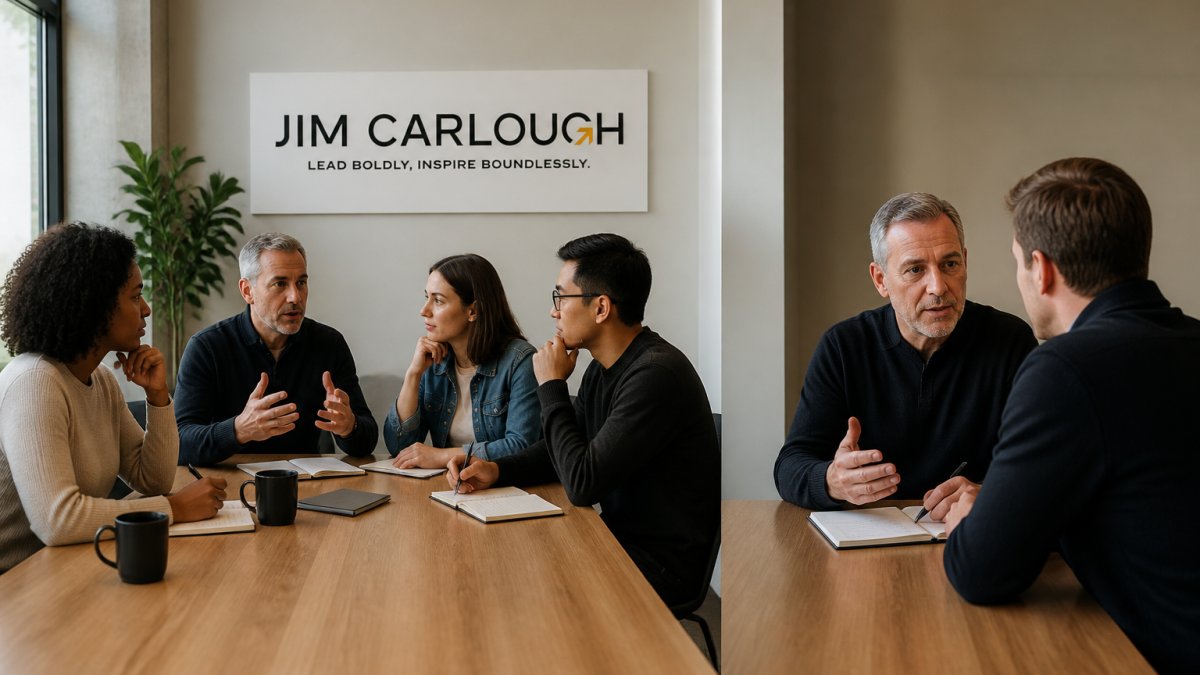
Group Coaching vs One-on-One Mentorship: A Guide
Table of Contents
- Group Coaching vs One-on-One Mentorship: Key Differences
- The Benefits of Group Coaching for Leadership Teams
- Leadership Coaching Program Examples: What Works in Real Organizations
- How Long Should a Leadership Development Program Duration Be?
- Leadership Coaching Questions That Drive Real Growth
- How to Measure Outcomes and Return on Investment
- Conclusion: Choosing the Right Format for Your Leaders
- Frequently Asked Questions
Last Updated: October 6, 2026
Group Coaching vs One-on-One Mentorship: Key Differences
Group coaching is a facilitated session where several leaders work toward individual goals at the same time. One-on-one mentorship is a private relationship where a more experienced person guides one mentee over a longer period.
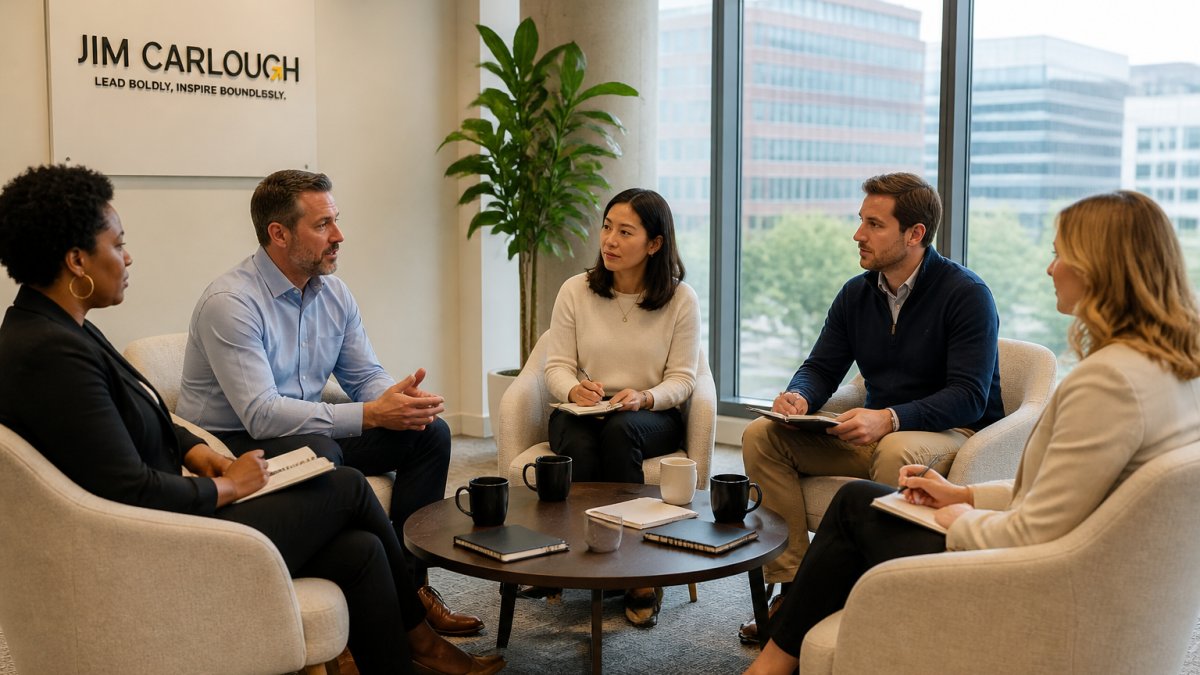
This guide from Jim Carlough breaks down when each format works, what it costs you in time, and how to measure whether it paid off.
Both formats build leadership skills. They just do it differently. Group coaching moves fast and builds peer accountability. One-on-one mentorship moves slower and goes deeper on career direction. Picking the wrong one wastes budget and momentum.
The Center for Creative Leadership's research on leadership development has long shown that leaders learn best through experience and relationships, not classroom lectures. Format matters more than content.
What Group Coaching Looks Like in Practice
A group coaching session usually runs 60 to 90 minutes with four to eight participants. A trained coach sets the structure, but each leader brings their own challenge to the table.
The group asks questions. Peers share what worked for them. The coach keeps the conversation on track and pushes for commitments.
Common features of group coaching:
- Fixed schedule, often biweekly or monthly
- Shared themes like communication or team engagement
- Peer accountability between sessions
- Lower cost per participant than private coaching
What One-on-One Mentorship Looks Like in Practice
One-on-one mentorship pairs a senior leader with a mentee for months or years. The agenda belongs to the mentee. The mentor shares experience, opens doors, and offers honest feedback.
This format fits career guidance and long-term growth. It rarely follows a script. Meetings happen when the mentee needs them, not on a fixed calendar.
Key traits of one-on-one mentorship:
- Long-term relationship, often a year or more
- Mentee sets the agenda and goals
- Mentor provides direction and access to networks
- Deeper personal development, slower pace
| Factor | Group Coaching | One-on-One Mentorship |
|---|---|---|
| Who sets the agenda | Coach and group | Mentee |
| Typical length | Weeks to months | A year or more |
| Cost per person | Lower | Higher |
| Best for | Peer learning, accountability | Career guidance, deep growth |
| Confidentiality | Shared within group | Private |
The Benefits of Group Coaching for Leadership Teams
Group coaching benefits show up fastest in teams that already work together. When peers coach each other, trust builds and silos break down. Leaders hear how a colleague solved the same problem last quarter, and that story often lands harder than a coach's framework, because the person telling it sits in the same seat.
The format also scales. A single coach can develop six to eight leaders at once, which stretches a tight training budget further. That matters when you are building a pipeline, not just polishing one executive. The trade-off is real: a group session gives each participant a fraction of the coach's attention that a one-on-one mentorship would.
Peer mentorship inside the group does real work. Participants give feedback, share resources, and hold each other to commitments between sessions. Shared learning sticks because it comes from someone facing the same pressure, not from a slide deck.
Group Dynamics, Confidentiality, and Psychological Safety
The benefits only hold if the room is safe. Three dynamics decide whether a group coaching cycle works or quietly falls apart:
- Uneven participation. Two or three voices dominate unless the coach actively rotates airtime. A common pattern is to open every session with a round-robin check-in so quiet members speak before the confident ones set the tone.
- Confidentiality limits. What is shared in a group is shared with everyone in it. Sensitive topics, a failed promotion, a conflict with a boss, a personal crisis, usually belong in one-on-one mentorship, not a peer circle. Set that expectation in writing before the first session.
- Psychological safety. Participants need to admit mistakes without losing standing. Coaches build this by modeling vulnerability first and by keeping the group small enough, typically four to eight people, that no one can hide.
A useful rule: group coaching works on skills, behavior, and shared challenges. One-on-one mentorship handles the personal, political, and confidential material. Keep that line clear and the sessions stay productive.
Cost, Time, and Access Trade-Offs
Group coaching is almost always cheaper per person than one-on-one mentorship, because the coach's hourly rate is split across the cohort. A one-on-one mentorship consumes the mentor's full attention for every hour, so the effective cost per leader is higher, and senior mentors often have less calendar availability than a professional coach.
The time commitment differs too. Group coaching runs on a fixed cadence, often biweekly or monthly for 60 to 90 minutes, plus light between-session work. One-on-one mentorship is more flexible but less predictable: meetings happen when the mentee needs them, which can mean long gaps or sudden bursts of demand.
Access is the hidden variable. A trained coach is available to anyone who pays. A great mentor is limited by relationship fit, seniority, and willingness to invest.
Leadership Coaching Program Examples: What Works in Real Organizations
Leadership coaching program examples tend to follow three shapes. Each one fits a different goal, and each has trade-offs.
Cohort programs. A group of emerging leaders meets monthly for six to twelve months. They work through a shared curriculum on communication, feedback, and decision-making. Best for building a bench of future managers.
Blended programs. Leaders get group sessions plus a few private coaching calls. The group handles skill-building and accountability. The private calls handle sensitive or personal challenges. This mix covers more ground than either format alone.
Mentorship pairs. A senior leader meets a rising leader one-on-one every few weeks. The mentee drives the agenda. Best for succession planning and career progression.
How Long Should a Leadership Development Program Duration Be?
Most leadership development programs run six to twelve months. Shorter cycles of four to six weeks work for a single skill, like giving feedback. Deeper identity and behavior change needs a year or more.
Duration should match the goal, not a calendar. Ask what the leader should do differently at the end. Then work backward to the time that takes.
A simple rule:
- One skill: 4 to 8 weeks
- Behavior change: 3 to 6 months
- Career and identity growth: 12 months or longer
Rushing this is the most common failure. Leaders need time to try new behavior, fail, and adjust. A weekend workshop rarely changes how someone leads under pressure.
Leadership Coaching Questions That Drive Real Growth
The best leadership coaching questions push past tactics and into identity. Questions like "What kind of leader do you want to be known as?" do more work than "How do you run a better meeting?"
Strong questions to bring into any session:
- What would change if you trusted your team more?
- Where are you avoiding a hard conversation, and why?
- What does success look like for the people you lead?
- Which of your habits is costing you influence?
- What would you do if you were not afraid of being wrong?
At Jim Carlough, we build sessions around character-driven leadership, not just skills. The goal is a leader who knows who they are and leads from that place. Our work centers on six foundational pillars that shape how a leader shows up under pressure.
How to Measure Outcomes and Return on Investment
Measure leadership development by behavior change, not attendance. Track what leaders do differently and how their teams respond. The harder question, and the one most programs skip, is how to compare outcomes when one group of leaders went through group coaching and another went through one-on-one mentorship.
Metrics That Work for Both Formats
- Goal attainment. Did the leader hit the specific outcome they named at the start? Group coaching tends to produce many small, shared goals; one-on-one mentorship tends to produce fewer, deeper ones.
- Skill development. Use a before-and-after self-assessment plus a manager rating on two or three named skills, not a vague "leadership" score.
- Retention of high-potential employees. Track whether participants stay and whether they move up. This is often the clearest business signal.
- Confidence and self-awareness. A short pre/post survey on how prepared leaders feel for their next role catches growth that promotion data lags.
- Participant satisfaction and engagement. Useful as a leading indicator, weak as a final verdict. High satisfaction with no behavior change means the program felt good and did little.
Comparing Group Coaching and One-on-One Mentorship
The two formats produce different evidence, so measure them differently:
| What to measure | Group coaching | One-on-one mentorship |
|---|---|---|
| Goal attainment | Many small goals, peer-visible | Fewer, deeper, private goals |
| Skill growth | Cohort-wide skill gains | Individual, targeted gains |
| Retention signal | Peer network and belonging | Sponsor advocacy and access |
| Cost per outcome | Lower cost per participant | Higher cost, deeper per-person return |
| Best evidence | 360 feedback across the cohort | Career progression and sponsorship |
A practical approach is to run both formats in the same cycle and compare them on the same two or three business metrics. That gives you a defensible answer to the question every budget owner asks: which format moved the number?
Tie It to a Business Number
Connect the program to a metric your CFO already watches. Better team engagement usually shows up in retention and productivity. When you can link the coaching to those numbers, the investment defends itself.
The Society for Human Resource Management's guidance on measuring training impact recommends linking development to business outcomes from day one. Set the metric before the program starts, not after. A simple rule: pick one behavior metric, one retention metric, and one business metric per cycle, and report all three.
Conclusion: Choosing the Right Format for Your Leaders
The right format depends on the goal. Pick group coaching when you need peer learning, faster scale, and shared accountability. Pick one-on-one mentorship when a leader needs deep career guidance and a long-term relationship.
Many organizations run both. Group sessions build skills across a team. Private mentorship shapes the next generation of leaders. That combination covers short-term performance and long-term succession at the same time.
If you want a program built around character, not just checklists, Jim Carlough can help. Our executive coaching and developmental programs focus on building confidence, clarity, and influence. We help leaders develop the human skills that AI cannot replace. Get started with Jim Carlough and build leaders who lead from who they are, not just their title.
Frequently Asked Questions
What is the difference between group coaching and one-on-one mentorship?
Group coaching brings together several leaders in a facilitated peer setting to work toward shared goals, with the coach guiding discussion and accountability. One-on-one mentorship pairs a single mentee with an experienced mentor who provides personalized career guidance and long-term development support. The key difference is direction: group coaching is typically short-term and goal-focused, while one-on-one mentorship builds a longer professional relationship centered on individual growth and knowledge sharing.
Is group coaching as effective as one-on-one mentorship?
Both formats produce strong results, but they serve different purposes. Group coaching benefits leaders who need accountability, peer learning, and shared problem-solving across a team. One-on-one mentorship excels when a leader needs confidential feedback, personalized career development, or help closing a specific performance gap. Many organizations combine both: group coaching for team development and one-on-one mentorship for high-potential individuals preparing for succession.
When should a leader choose group coaching over individual mentorship?
Choose group coaching when your goal is building collaboration, shared learning, or a leadership pipeline across multiple people at once. It works well when several mid-level leaders face similar challenges, such as improving team engagement or preparing for broader responsibilities. Individual mentorship fits better when one person needs focused career guidance, confidential support, or development in areas they cannot explore openly in a group setting.
How do you measure the success of a leadership development program?
Measure outcomes using both qualitative and quantitative markers. Track performance improvement through 360-degree feedback, engagement scores, retention rates, and promotion velocity for participants. For group coaching, assess whether peer accountability and skill development translated into better team results. For one-on-one mentorship, evaluate career progression, goal completion, and the mentee's confidence in their leadership role. Set baseline metrics before the program begins so you can compare results after six to twelve months.


Helping leaders build confidence, clarity, and influence through character-driven leadership.


Quick Links

Helping leaders build confidence, clarity, and influence through character-driven leadership.